

Overview
Pamukkale is one of Turkey’s most extraordinary natural wonders, located in the province of Denizli in southwestern Anatolia. Famous for its dazzling white travertine terraces formed by mineral-rich thermal waters, Pamukkale, meaning “Cotton Castle” in Turkish, is one of the country’s most iconic landmarks. Combined with the ancient Greco-Roman city of Hierapolis, the site forms a UNESCO World Heritage destination where natural beauty and archaeological heritage coexist in a spectacular setting.
Best Time to Visit
The best months to visit Pamukkale are April to June and September to October, when temperatures are comfortable for walking across the terraces and exploring the archaeological sites.
Spring offers green landscapes and pleasant conditions, while autumn provides excellent weather and fewer crowds. Summer can be very hot, especially during the middle of the day.
Getting Around
Pamukkale is easy to explore on foot.
Visitors can enjoy:
- Walking across the travertine terraces
- Exploring the ruins of Hierapolis
- Visiting thermal pools
- Scenic viewpoints
- Archaeological trails
- Short excursions into the Denizli region
A car is useful for exploring nearby attractions, although the main site can be visited independently.
Safety and Local Etiquette
Pamukkale is a safe and welcoming destination. Normal precautions are sufficient throughout the area.
Visitors should:
- Walk carefully on wet travertine surfaces.
- Follow designated visitor pathways.
- Respect archaeological monuments and protected areas.
- Avoid damaging natural formations.
- Respect cultural and historical heritage.
Food and Water
Tap water is generally safe for basic use, although many visitors prefer bottled water.
Pamukkale is known for:
- Turkish kebabs
- Gözleme
- Traditional Anatolian cuisine
- Turkish sweets
- Fresh local produce
- Turkish tea
- Regional wines
Restaurants around the site offer a wide range of traditional Turkish dishes.
Day Trips and Excursions
- Denizli — the regional capital with museums, shopping, and local culture.
- Laodicea — one of Turkey’s most important ancient cities, featuring impressive Roman ruins.
- Aphrodisias — a UNESCO World Heritage archaeological site famous for its marble sculptures and ancient monuments.
- Lake Salda — renowned for its turquoise waters and striking white shores.
- Karahayıt — known for its distinctive red thermal springs and wellness facilities.
- Isparta — famous for rose cultivation and nearby natural landscapes.
Essence of Pamukkale
Pamukkale offers one of the most unique landscapes in the world. The combination of thermal waters, brilliant white terraces, and ancient ruins creates a destination where nature and history blend seamlessly. For centuries, people have visited the area seeking relaxation, healing, and inspiration, making Pamukkale one of Turkey’s most enduring attractions.
Highlights in Pamukkale
The main highlights include the spectacular Travertine Terraces, the ancient city of Hierapolis, the famous Antique Pool (Cleopatra’s Pool), the remarkably preserved Roman Theatre, the extensive archaeological remains scattered throughout Hierapolis, the thermal springs, and the panoramic viewpoints overlooking the Menderes Valley. Together, these attractions make Pamukkale one of the most remarkable UNESCO sites in the Mediterranean region.


- Pamukkale is one of Turkey’s most famous UNESCO World Heritage Sites.
- The white travertine terraces were formed by mineral-rich thermal waters over thousands of years.
- Visitors must remove their shoes when walking on designated sections of the travertines.
- Tap water is generally safe for basic use, although bottled water is commonly preferred.
- Hierapolis was an important Roman spa city built above the thermal springs.
- The Antique Pool allows visitors to swim among submerged Roman columns.
- Early morning and late afternoon provide the best lighting conditions for photography.
- The destination is safe and visitor-friendly; normal precautions are sufficient.
- Credit and debit cards are widely accepted in most tourist facilities.
- The official currency is the Turkish Lira (TRY).
- Comfortable footwear is recommended for exploring the archaeological site.
- Respect the protected natural formations and archaeological heritage when visiting.
Pamukkale enjoys a Mediterranean climate with inland influences, characterised by hot summers and mild winters.
- Spring (March to May) — pleasant temperatures and ideal sightseeing conditions.
- Summer (June to August) — hot and dry, with temperatures generally ranging between 30°C and 38°C.
- Autumn (September to November) — comfortable weather and excellent conditions for exploring the terraces and archaeological sites.
- Winter (December to February) — mild temperatures, typically between 5°C and 15°C, with occasional rainfall.
The region enjoys abundant sunshine throughout most of the year.
Today:


Visiting Pamukkale top image
They dissolve the calcium carbonate, and deposit it further on, creating a white landscape, where terraces retaining the water compose a marvelous landscape.
I don’t know if nature made it all, or had the help of men hands, but the results are fabulous, and men’s contribution, if it happened is to be saluted.
And what about another hot spring in your hotel pool?
The Pools
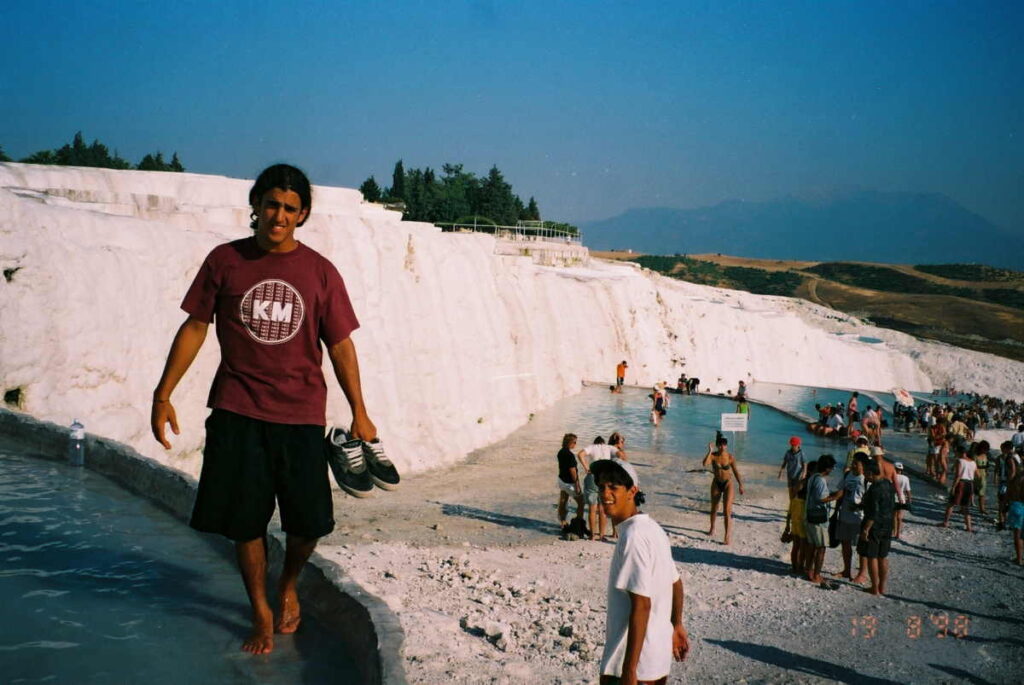
It is a beautiful sight from distance (smaller than expected), the white mountain with the water running slowly downwards.
It is still pretty when you approach, but don’t be mistaken by the usual photos of people in the water: It’s not a bathing area.
The crowds follow the course of the water, here and there put their feet in a small natural pool, and it’s done.
Anyway, with all those people it couldn’t be otherwise.

Sleeping in Pamukkale – 1st great visit
If you want to easily publish your own experiences, after registering you may use the form below. It will be added after revision. You may use text, photos till 20Mb or video. For a more complex publication click here.
Publishing form
You need to be logged in to view this page
Your trip will be perfect with the help of our partners
For a great experience:
For your safety:

For your comfort:
For cheap flights:
For local displacements:
 English
 Português