

Overview
Figueres is one of Catalonia’s most intriguing cultural destinations — a lively town known worldwide as the birthplace of Salvador Dalí and home to the surreal and iconic Teatre‑Museu Dalí. Surrounded by Empordà landscapes, vineyards, and medieval villages, Figueres blends art, history, and Catalan identity. It’s a destination for travelers who enjoy museums, gastronomy, and exploring the quieter side of northeastern Spain.
Best Time to Visit
The city can be visited year‑round, but each season offers a different atmosphere:
- Spring (Apr–Jun) — mild temperatures, ideal for walking the town and visiting museums.
- Summer (Jul–Sep) — warm and lively, perfect for combining Figueres with Costa Brava beaches.
- Autumn (Sep–Nov) — fewer crowds, excellent for gastronomy and cultural visits.
- Winter (Dec–Mar) — quiet and cool, ideal for slow travel and museum days.
The inland Mediterranean climate ensures warm summers and mild winters.
Getting Around
Figueres is compact and easy to explore:
- Walking — ideal for the historic center and main museums.
- Train — high‑speed AVE connects Figueres to Barcelona and Girona.
- Car — useful for exploring nearby villages and Costa Brava beaches.
- Parking — available near the center, though some streets are narrow.
The town’s layout is simple, with most highlights within short walking distance.
Safety and Local Etiquette
The area is safe and welcoming. Summer heat can be strong — bring water and sunscreen. Respect quiet residential streets and cultural sites. Locals appreciate politeness, calm behavior, and interest in Catalan culture and art.
Food and Water
Figueres’ gastronomy reflects Empordà tradition. Expect:
- Suquet de peix
- Botifarra
- Pa amb tomàquet
- Seafood and rice dishes
- Local wines from Empordà DO
Tap water is safe to drink. Restaurants and cafés are concentrated around the historic center and main squares.
Day Trips and Excursions
Figueres is perfectly located for exploring northern Catalonia. Highlights include:
Within Figueres
- Teatre‑Museu Dalí — the town’s iconic landmark and one of Spain’s most visited museums.
- Museu del Joguet de Catalunya — charming toy museum.
- Castell de Sant Ferran — one of Europe’s largest fortresses.
- Rambla de Figueres — lively boulevard with cafés and shops.
- Casa Natal de Dalí — birthplace of the artist.
Nearby Destinations
- Cadaqués — coastal village deeply connected to Dalí.
- Portlligat — Dalí’s house‑museum by the sea.
- Cap de Creus — dramatic coastal landscapes and viewpoints.
- Besalú — medieval village with Romanesque bridge.
- Girona — historic city with Jewish quarter and cathedral.
- Aiguamolls de l’Empordà — wetlands and birdwatching routes.
For longer trips, you can reach Barcelona, Perpignan, or the Pyrenees.
The essence of Figueres
Figueres is defined by its artistic spirit — a town shaped by Dalí’s imagination — and by the quiet rhythm of Empordà landscapes that surround it. It’s a place where culture feels alive, where museums anchor daily life, and where every walk reveals Catalonia’s creative soul. The essence of Figueres lies in its identity: artistic, welcoming, and unmistakably Catalan.
Highlights in Figueres:
I don’t think I’m wrong if I say that ninety percent of visitors come specifically to the museum. Salvador, the museum, Dali, and if that’s not enough, a castle and church.


- Figueres is located in the province of Girona, in northeastern Catalonia, close to the French border.
- The city is internationally famous as the birthplace of Salvador Dalí.
- Tap water is safe to drink.
- The main attraction is the Dalí Theatre-Museum, inaugurated in 1974 and home to the world’s largest collection of Dalí’s works.
- The museum was conceived and designed by Salvador Dalí himself and is often described as the world’s largest surrealist object.
- Figueres is part of the famous Dalinian Triangle, together with Dalí’s House in Portlligat and Gala Dalí Castle in Púbol.
- The enormous Sant Ferran Castle is one of the largest 18th-century fortresses in Europe.
- The historic centre features pleasant squares, traditional Catalan architecture, and pedestrian shopping streets.
- Figueres serves as an excellent base for exploring the Costa Brava, Girona, Cadaqués, Roses, and the Empordà region.
- The nearby town of Cadaqués was closely associated with Salvador Dalí and remains one of Catalonia’s most picturesque coastal destinations.
- The region is renowned for Mediterranean cuisine, seafood, Empordà wines, olive oil, cured meats, and Catalan specialities.
- The city is well connected by high-speed rail to Barcelona, Girona, and France.
- The destination is safe and visitor-friendly; normal precautions are generally sufficient.
- Credit and debit cards are widely accepted.
- The official currency is the Euro (€).
- Respect museums, cultural sites, historic monuments, and local traditions when visiting.
Figueres enjoys a Mediterranean climate, with warm summers, mild winters, and plenty of sunshine throughout the year. Located in the Alt Empordà region of Catalonia, the city is influenced by both the Mediterranean Sea and the nearby Pyrenees.
- Spring (March to May) – pleasant temperatures, blooming landscapes, and excellent conditions for sightseeing and cultural visits.
- Summer (June to August) – warm and sunny, with temperatures typically ranging between 25°C and 33°C.
- Autumn (September to November) – mild weather, fewer visitors, and ideal conditions for exploring the city and surrounding Costa Brava.
- Winter (December to February) – generally mild, with temperatures ranging between 5°C and 15°C.
Spring and autumn are widely considered the best times to visit Figueres.
Today:
🌐 Regional connection
This destination is part of the Catalonia Cluster, a curated region showcasing Mediterranean beaches, historic cities, mountain landscapes, cultural heritage, and some of Spain’s most diverse travel experiences.

Figueres – 1st good visit
Visiting Figueres top attraction
Always Dali

Salvador Dali = Avida Dollars
As millions, I went to Figueres only to see Dali’s museum ( In Croatia I made a friend from Figueres, which it was supposed to meet in Roses, but things didn’t work, so we lost contact).
A short ride across town confirmed that everything leads to Dali.
And it seems that all the commerce turns around him and Miro.
Dali Museum

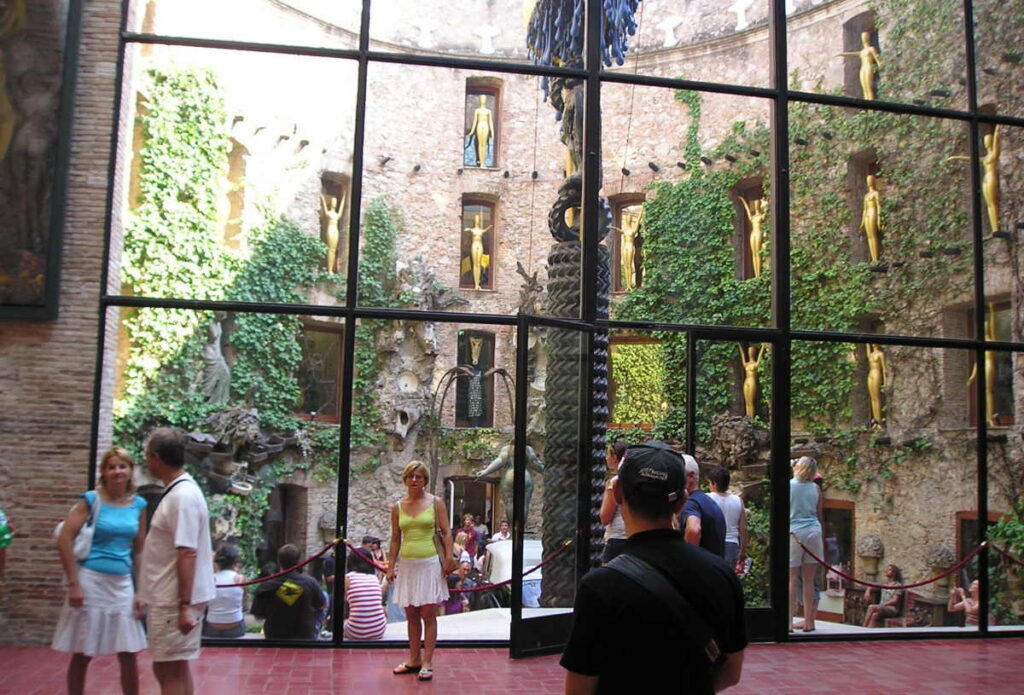
From the ruins of a theater bombed in Civil War, Dali built a museum to host his final works.
The building is rather common, only its finishing and a few details revealing the eccentricity of the author.
Only remarkable are the main courtyard, and the respect shown to the old facade of the theater.

Dali Museum – the paintings
It was a small disappointment the collection on display.
Of course, dollars were in command all Dali’s life, and the best works were sold, but, even so, I really expected more.
Funny, his jokes with Velasquez and the classics.

Dali’s sculptures
It is in the volumes that the imagination and eccentricity of the creator is more present in all the museum.
The forms, their position, the organization of specific looking points, more than the paintings… that’s Dali.
 Dali
 Dali
Would I ever go to Figueres without Dali?

No!
For sure! It seemed a nice place but… with what to attract a tourist without Dali?
I tried to read, to search something else, in a not so small city – more than 40000 inhabitants but… everything leads to Gala foundation, which means Dali.
Anyway, this single reason is more than enough to a visit: since you’re in Costa Brava or nearby, there’s no excuse!
If you want to easily publish your own experiences, after registering you may use the form below. It will be added after revision. You may use text, photos till 20Mb or video. For a more complex publication click here.
Publishing form
You need to be logged in to view this page
Your trip will be perfect with the help of our partners
For a great experience:
For your safety:
For your comfort:
For cheap flights:
For local displacements:
 English
 Português