

Overview
Porto rises along the Douro River with a character shaped by steep hills, tiled façades and centuries of maritime trade. The city blends tradition and creativity, where medieval lanes, wine cellars and modern culture coexist naturally. Its atmosphere feels warm, expressive and unmistakably Portuguese, defined by river light and granite charm.
Best time to visit
The best time to visit is from April to October, when mild temperatures and long days make exploring ideal. Spring brings blossoms and soft Atlantic breezes. Summer offers lively streets and riverside life. Autumn adds golden tones and calm walks. Winter is cool and atmospheric, perfect for cosy cafés and cultural visits.
Getting around
Porto is easy to explore on foot, though its hills add character to every route. The metro, trams and buses connect major sights, while the riverfront provides scenic walks. The historic center, Ribeira, Clérigos and Aliados are all close together. Movement reflects the blend of heritage, comfort and urban energy.
Safety and local etiquette
Porto is safe and welcoming, with a friendly northern Portuguese atmosphere. Normal precautions apply around busy tourist areas and evening streets. Locals value politeness, warm conversation and respect for cultural spaces. Visitors are encouraged to greet people kindly and enjoy the relaxed rhythm of city life.
Food and water
Porto offers excellent regional cuisine — francesinha, cod dishes, grilled meats, pastries and Douro wines. Restaurants and taverns serve hearty meals with warm hospitality. Tap water is safe to drink. Dining here feels social and comforting, reflecting the city’s culinary pride and deep traditions.
Day Trips and Excursions

- Vila Nova de Gaia – Home of the famous Port wine cellars and riverside views.
- Guimarães – UNESCO World Heritage city known as the birthplace of Portugal.
- Braga – Historic city famous for Bom Jesus do Monte and religious heritage.
- Amarante – Charming riverside town renowned for its bridge, monastery and pastries.
- Aveiro – Known as the “Venice of Portugal” for its canals and colorful moliceiro boats.
- Coimbra – Historic university city and former capital of Portugal.
- Douro Valley – UNESCO World Heritage wine region famous for vineyards and river cruises.
- Peso da Régua – Heart of the Douro wine region.
- Lamego – Historic town known for the Sanctuary of Nossa Senhora dos Remédios.
- Viana do Castelo – Coastal city celebrated for maritime traditions and stunning viewpoints.
- Arouca – Famous for the Arouca 516 suspension bridge and Paiva Walkways.
- Peneda-Gerês National Park – Portugal’s only national park, known for mountains, waterfalls and wildlife.
- Matosinhos – Coastal destination renowned for beaches, seafood and surfing.
- Espinho – Popular seaside resort known for beaches and casinos.
- Ponte de Lima – Portugal’s oldest town, famous for its Roman bridge and historic centre.
These destinations complement a visit to Porto with a combination of UNESCO heritage, wine regions, historic towns, coastal scenery, riverside landscapes and some of northern Portugal’s most celebrated attractions.
Essence of Porto
The essence of Porto lies in its harmony between river, stone and centuries of northern character. Sunlight touches tiled houses, boats glide along the Douro and the city breathes a rhythm shaped by tradition and creativity. It is a place where calm meets intensity, where heritage remains vivid and where every moment carries a warm, expressive Portuguese tone. Porto embodies the soulful heart of Portugal — historic, scenic and unmistakably authentic.
Highlights in Porto

- Ribeira District – UNESCO-listed riverside neighbourhood with colourful historic buildings.
- Dom Luís I Bridge – Porto’s most iconic landmark spanning the Douro River.
- Port Wine Cellars – Historic wine lodges located in Vila Nova de Gaia.
- Livraria Lello – One of the world’s most beautiful bookstores.
- Clérigos Tower – Offering panoramic views over the city.
- São Bento Railway Station – Famous for its magnificent azulejo tile panels.
- Porto Cathedral (Sé do Porto) – One of the city’s most important historic monuments.
- Palácio da Bolsa – Impressive 19th-century neoclassical building.
- Church of São Francisco – Renowned for its lavish gilded interior.
- Foz do Douro – Elegant district where the Douro River meets the Atlantic Ocean.
- Crystal Palace Gardens – Beautiful gardens with panoramic river views.
- Bolhão Market – Traditional market showcasing local gastronomy and culture.
- Casa da Música – Contemporary architectural masterpiece and cultural venue.
- Rua das Flores – One of Porto’s most charming and lively streets.
- Douro River Cruises – One of the best ways to experience the city’s scenery.


- Porto is Portugal’s second-largest city and one of the country’s most important cultural, commercial, and historical centres.
- The historic centre of Porto is a UNESCO World Heritage Site.
- Tap water is safe to drink and of excellent quality.
- The city is world-famous for Port Wine, traditionally aged in the wine cellars of neighbouring Vila Nova de Gaia.
- The Douro River is the heart of the city and offers some of Portugal’s most iconic urban landscapes.
- The Dom Luís I Bridge is one of Porto’s most recognisable landmarks.
- Major attractions include the Clérigos Tower, São Bento Station, Livraria Lello, Porto Cathedral, Ribeira District, and the Palácio da Bolsa.
- Porto combines medieval streets, Baroque architecture, contemporary culture, and a vibrant gastronomic scene.
- The nearby Atlantic coastline offers attractive beaches such as Matosinhos and Foz do Douro.
- Traditional gastronomy includes Francesinha, Tripas à Moda do Porto, Bacalhau dishes, seafood, and regional pastries.
- Porto serves as the gateway to the famous Douro Valley wine region.
- The city is well connected by metro, train, buses, river cruises, and Francisco Sá Carneiro Airport.
- The destination is safe and visitor-friendly; normal precautions are generally sufficient.
- Credit and debit cards are widely accepted throughout the city.
- The official currency is the Euro (€).
- Respect historic monuments, wine heritage, local traditions, and residential neighbourhoods when visiting.
Porto enjoys a Mediterranean climate with strong Atlantic influences, characterised by mild temperatures, moderate rainfall, and comfortable conditions throughout much of the year. Its location at the mouth of the Douro River creates a pleasant environment for year-round tourism.
- Spring (March to May) — mild temperatures, blooming gardens, and ideal conditions for exploring the historic centre, riverside districts, and nearby coastal areas.
- Summer (June to August) — warm and generally sunny, with temperatures typically ranging between 22°C and 30°C. Atlantic breezes help keep temperatures comfortable.
- Autumn (September to November) — pleasant weather, excellent conditions for sightseeing and gastronomy, and beautiful light along the Douro River.
- Winter (December to February) — mild conditions, generally ranging between 5°C and 15°C, with occasional rainfall and Atlantic storms.
Spring and early autumn are widely considered the best seasons to visit Porto.
Today:
🌐 Regional connection
This destination is part of the North Coastal Cluster, a curated region that connects coastal towns, heritage sites and Atlantic landscapes across northern Portugal.


 “Bairristas”
 “Bairristas”
Searching for the translation of the word that better defines the locals from Porto – “Bairristas” I found: “defender of local interests”, “regionalist” “narrow-minded”. Not knowing what to choose, I choose… all.
The fever they use to promote and defend their town is a little aggressive for those from other places, specially from the south.
That’s why for a long time, I didn’t feel a great sympathy for this town.
Football (soccer) enhances the distance, with all the dirty (even criminal) means used to support the local teams.
Anyway, after a rational analysis, I must admit two things: all the people that I personally know in Porto are gentle and welcoming, and the town itself it’s beautiful, and surprisingly better each time I return. So, let’s forget the “bairrismo” and football, and open myself to the city. I promise a deeper visit one of these days.
PS – I made several other visits, to the splendid city of Porto, getting better each day. Tips will continue being added, but I will keep the old ones, with images and sensations from a long time before the sovereignty of tourism.
Eiffel’s hand

The old bridge of D. Luis, still in use, is one of the landmarks of Porto.
Though far from the spectacularism of the Eiffel tower in Paris, the geniality of the master is undeniable, and the style easily recognizable.
The lower platform is great to allow a walking visit of Gaia’s caves where Port wine invites you.
Clérigos Tower


This Baroque tower built in the 18th century by Nicolau Nasoni is, maybe, the most famous building of Porto.

Centrally located, it’s easy to reach and quick to see, being almost impossible to stroll in historic Porto without stumbling on it, and if you have the guts to climb its 240 steps, they say that the views are rewarding (I never risked, but do believe!).
Website: Clerigos
Aliados avenue

The central square of Porto is the place where everything socially relevant happens.
Dominated by town hall, it is a very harmonious square (they call it Aliados avenue) that no one can miss, because it is in the middle of… everything.
Amidst all the many interesting buildings, forget McDonald’s advertising and look at the building – 9GAG considered it “the most beautiful in the world”

Cathedral

Reading in Lifecooler that:
“Porto Cathedral is the cradle of the city, which has developed from here. It is a must-see monument, because of its artistic treasures. Built in the 12th century in Romanic style, the cathedral has deeply changed throughout time. The façade has two towers and in the middle of them, a rose window. In the inside, the naves have a vault shape. At the end of the central nave, you will find the high choir, illuminated by a Gothic style rose window. The main chapel was built in the 17th century in classic style, dominated by marbles of several colors. The urn with the remains of Holy São Pantaleão, city patron saint, is also a peculiar note worth highlighting.”
.. I should be ashamed! For more than 30 years I only saw it from distance. To be honest, I visited it but forgot what I saw.
Of course, it was a priority in my recent visits to Porto. Twice!
Bourse Palace

One of my wished visits in Porto is the Arab room, in this palace that now houses the Commercial Association of Porto. That’s the reason why they only allow guided visits, and… not always. That´s why I had to skip it once more – a conference was being prepared, and visits were suspended.
I saw it in TV, it looks nice, but pictures are forbidden, so I don’t know how someone obtained the one that I found in Panoramio.
othercontact: correio@cciporto.pt
Phone: +351 22 339 9000

Well, tourism is king, and everything adapts. Visits continue to be in groups, but photos have been liberalized. I show just one of the many that I took, to confirm that it is not to be missed, and you can add yours.
Infante square

Located facing the Bourse palace, ans surrounded by other beautiful buildings, this square, once occupied by a convent is a great point to those who travel by car, because it has an underground parking, and a perfect location to visit the historic centre of town.
The square’s name is given by the monument to Henry, the navigator, erected in 1900.
Palácio de Cristal

People keeps talking about “Palácio de Cristal” even after its demolition in 1953, to give place to the sports pavilion, that initially kept the name and later was baptized “Rosa Mota”.
It’s a massive construction, in a garden overlooking the river, used to all kind of sports, even our… dancing.
We didn’t dance there yet, only watched, but we will… soon!
The gardens of Palácio de Cristal

This small but lovely garden, around the sports pavilion, is a balcony over the river, with a nice area to rest with a good book, to chat with friends, or to make a picnic, as we did.
A very pleasant spot in Porto.

S. Francisco church

This church is an absolute “Must see”.
So rich, in its gilded interiors, that picture is forbidden.
It is a Gothic church from the 14th century, but its great attraction is the baroque decoration from the 18th.
The ticket costs 4€ and allows free entrance at the adjacent museum.

S Francisco museum
Yes, this is a two in one. If the church is something not to be missed, then the museum is… free!
Some paintings, some furniture, some sculpture, the catacombs… well, it’s free!
S Nicolau church

Burnt in 1758 and rebuilt four years later, this small church close to St Francisco, mixes Neoclassical and Baroque styles.
With Rococo decoration it has a reasonable collection of gold and silver pieces.

Boavista – Oficial version

In the beginning of the 19th century the troops of Napoleon invaded and occupied Portugal.
Lisbon has been taken, but not Porto. After a dramatic resistance, Portugal won the war, with the help of the English army. To celebrate the resistance was built a monument almost 50 meters high, with precious sculptures, in one of the main squares of Porto.
Close to it, in the beginning of the long avenue that leads to the seafront, the new building of casa da Música deserves your attention.
In Paris, the “Arc du Triomphe” celebrates, among other, the victory of Oporto (I explain the error in my Paris page).
Do you want to laugh (or, at least, have a smile)?
Read the Moor version
Casa da música
The New White Elephant
The worst of Porto is… jealousy!
Lisbon spent millions building a white elephant to cultural events – CCB, the Cultural Center of Belem, and Porto shouldn’t stay behind. Many millions later, here we have, in Boavista square, this immense and disputed block, able to organize all kind of performances.
Join the discussion, and if you want something more then a drink to fill the night , it must be your first search.
Website: Casa da Musica
Rabelo boats

Once used to bring the wine down the river, these beautiful boats are only a touristy attraction today.
Most of them are only anchored as decoration for the wineries, only sailing in festive days, but a few are available to a small trip in the river.
Why not?
Congratulations

Every time I went to Porto, I came with the sensation of disappointment, because it was easy to see the potential of this quarter to boost Porto’s authenticity, but the ruined look, dirtiness and bad frequency spoiled everything.
I went there one more time, and… congratulations.
The recuperation was well achieved, the colors glow in the reflections in the water, and visitors are well received, feeling comfortable and pleased.
An example to continue and follow.
Ribeira

The central point of tourism in the city is Ribeira, the traditional riverside neighborhood, today a huge concentration of restaurants and bars, where, sometimes, you can find a Portuguese.
Close to the best attractions in the city, and the popular crossing to Gaia, it is the liveliest area, where the care and successful efforts of recovery and beautification have protected the typical image of the neighborhood.
Alfândega

Departing point for several cruises along the river, this quarter, close to Ribeira, is also being restored, and shows a clean and nice face to the river.
Well, in the back there was still much work to be done the last time we were there.
Foz

Yes, Porto is extremely jealous of Lisbon and doesn’t accept losing in any circumstance.
Lisbon has its coast of Estoril, and Porto has… the Foz.
However, here, this city must accept the defeat. The walk along the river is beautiful, lively, but the sea doesn’t help, and beach is something to forget except for locals.
Defeat? I’m I crazy? Who invented the “francesinhas”?
Serra do Pilar

Just across the river (so, officially in Gaia, I think), in a steep hill, there is the monastery of Serra do Pilar.
Though not yet open to public visit, it’s the perfect place to stop and enjoy the best sight over the river and Porto.
It’s not difficult to reach, at your right, just before you enter the upper platform of D Luis bridge.

View from Serra do Pilar in 1977
Lions fountain
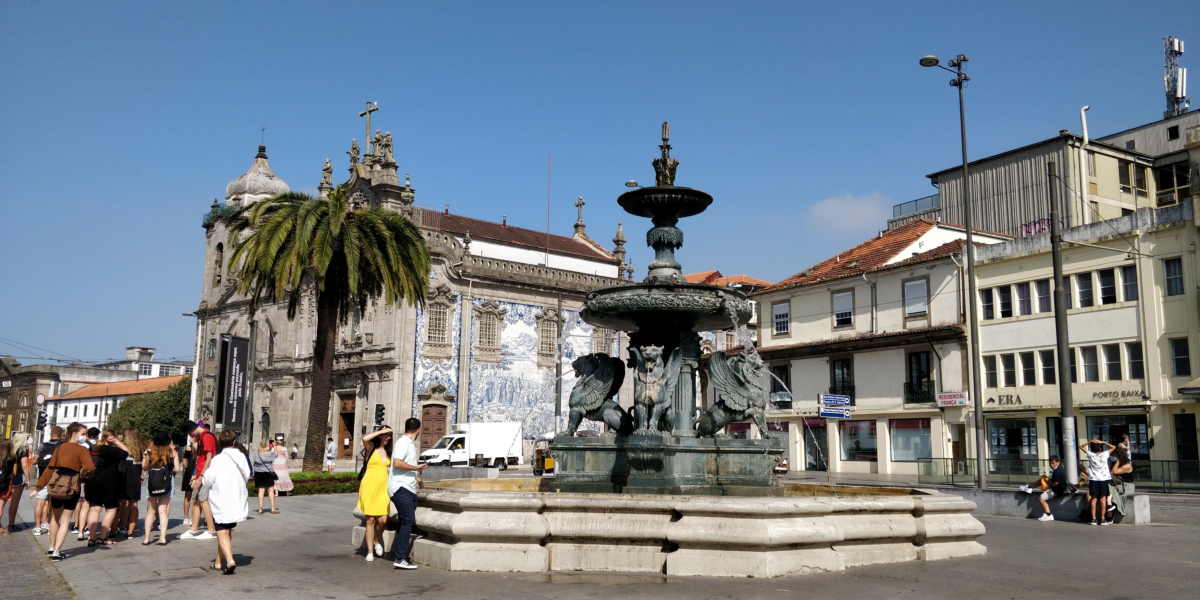
In the center of the beautiful square Gomes Teixeira stands the fountain of lions.
Built in 1886 as part of Porto’s modern water supply project, the fountain was designed by French sculptor Charles Lebourg and cast in France. It features four bronze lions, each facing a cardinal direction, symbolizing strength and resilience. AIs surrounded by several beautiful buidings.
Carmelites and Carmo churches
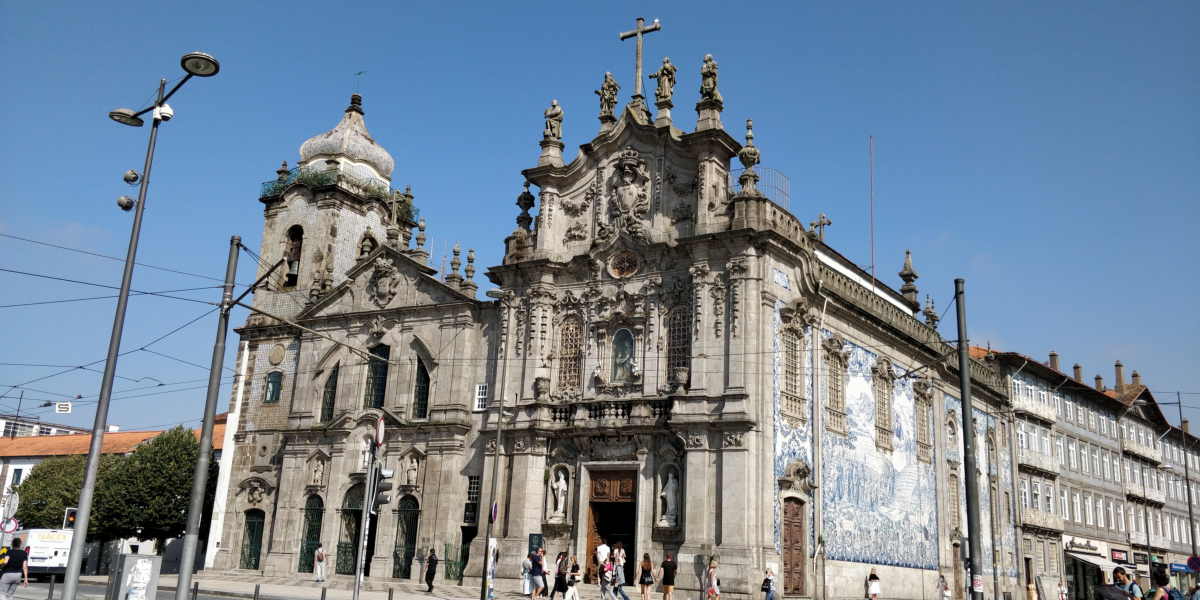
The most outstanding building in the square is the uncommon image of two churches deeply connected.
The Church of Carmelitas, built in the early 17th century, reflects Baroque style with granite façades, niches of saints, and a bell tower decorated with azulejos. It once served as a convent and even as military barracks during the French invasions. At its side, the Carmo church, completed in the 18th century, showcases Rococo architecture.
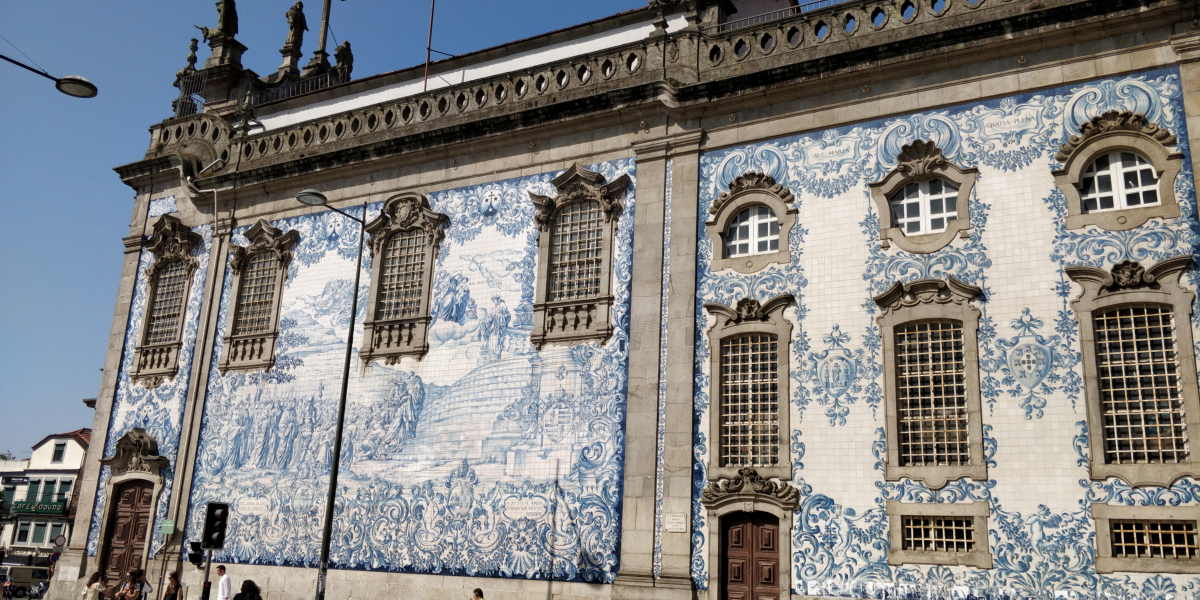
Its highlight is the vast 1912 azulejo panel depicting Carmelite traditions.
The hidden house
The most picturesque detail is the so called “Hidden house”, linking the two churches.
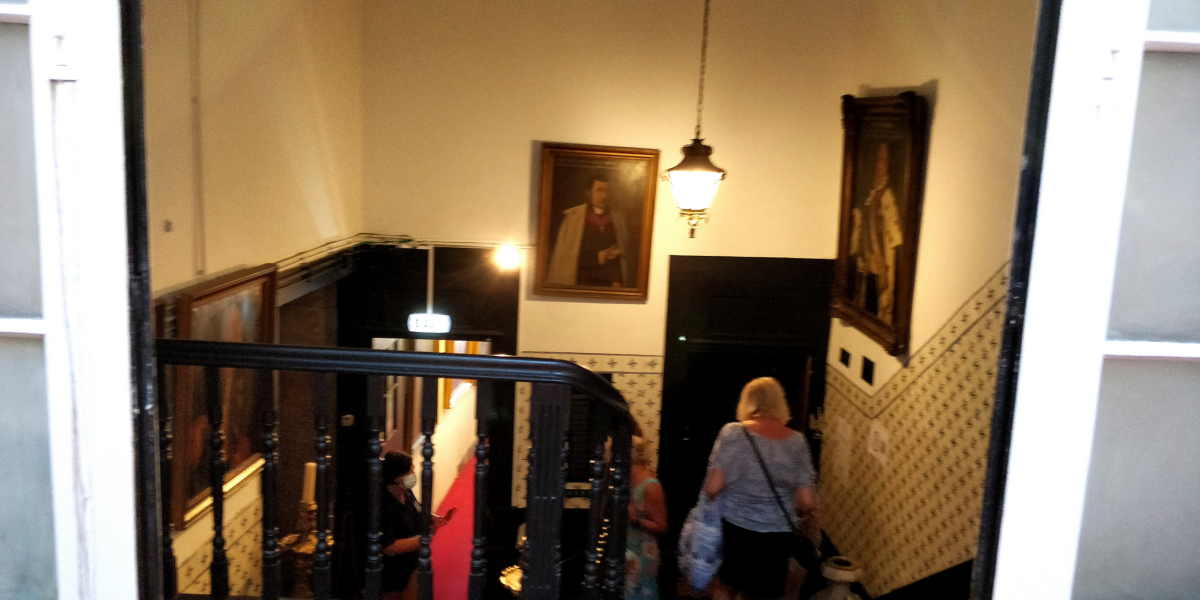
This narrow residence, barely one meter wide, was built in the 18th century to comply with regulations that prohibited two churches from sharing a wall. The house served a practical purpose, preventing direct contact between monks and nuns, while also filling the gap left by the separation. Despite its tiny size, the three‑story building contained a living room, bedroom, study, and kitchen.
It is considered the narrowest house in Porto and a fascinating stop for visitors exploring the city’s historic center, generally disputing each square inch shoulder by shoulder.
University
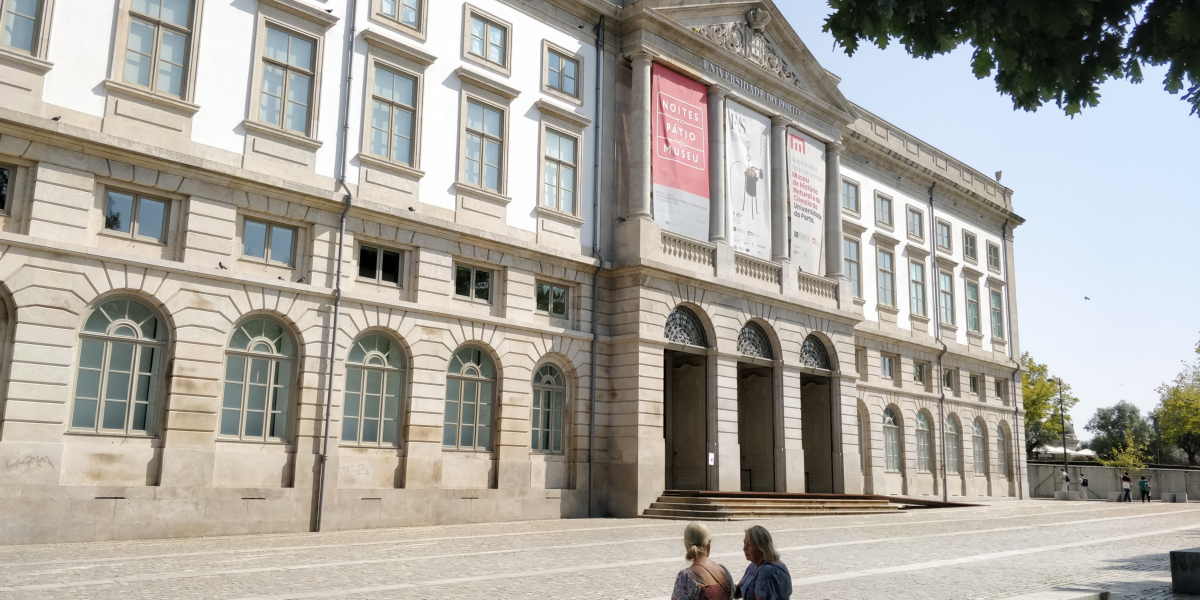
i n the opposite side of the Lions fountain stands the Natural History and Science Museum of the University of Porto, housed in the historic rectory building.
Founded in 2015 through the merger of the university’s Natural History and Science museums, it preserves centuries of collections in geology, paleontology, zoology, botany, archaeology, and ethnography. The central hub in the rectory is currently under restructuring, hosting temporary exhibitions, while its other poles include the Galeria da Biodiversidade – Centro Ciência Viva and the Botanical Garden of Porto.
Cordoaria Garden
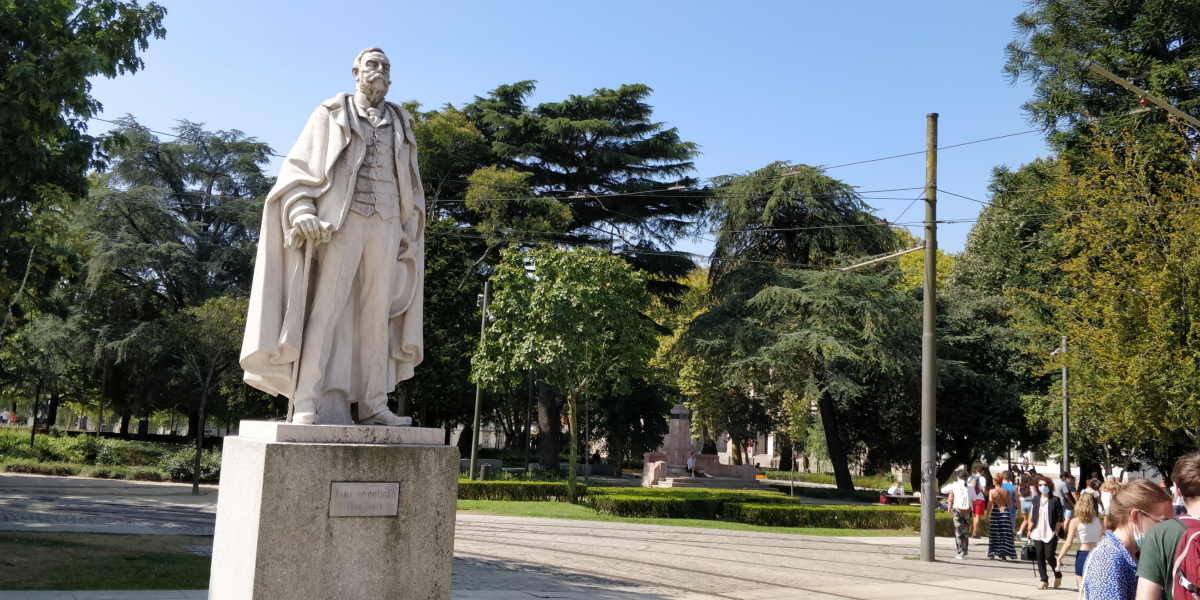
Closing the square, the Cordoaria Garden, officially Jardim de João Chagas, is a historic green space in central Porto.
Created in 1865 by German landscape architect Émile David, it transformed the former rope‑making grounds into a romantic urban park. The garden is famous for its rows of centuries‑old plane trees, winding paths, and sculptures. Over time, it has served as a venue for fairs, markets, and cultural events.
Photographers museum
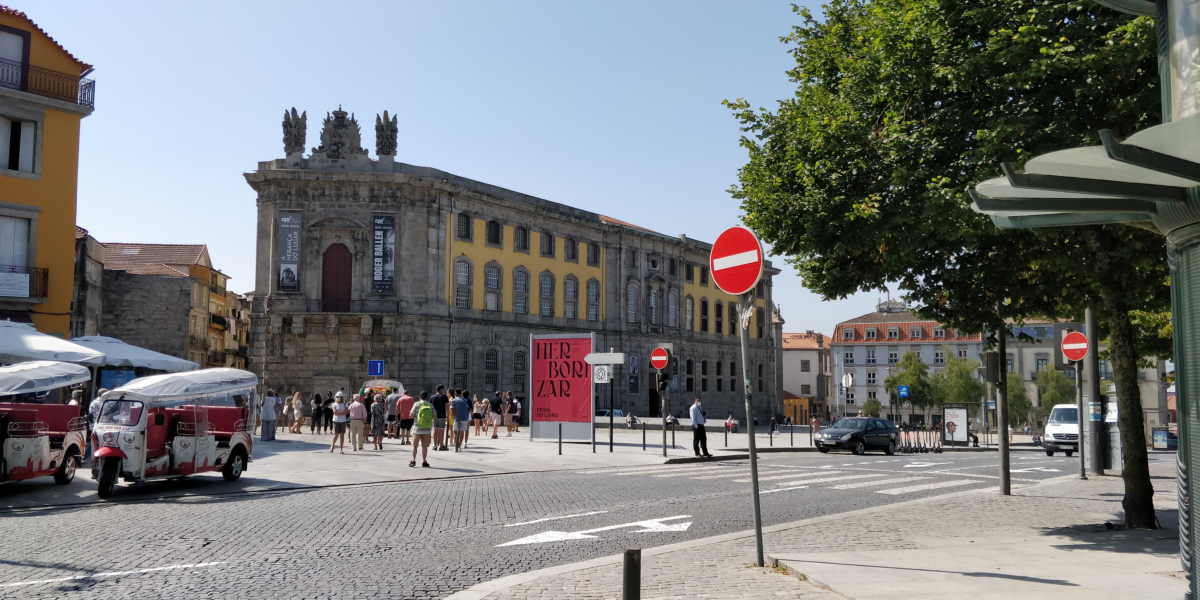
Located opposite the Cordoaria Garden, the “Centro Português de Fotografia”, housed in the former Cadeia da Relação prison in Porto, is a cultural landmark dedicated to photography.
Established in 1997, the museum occupies a 18th‑century building that once served as both courthouse and jail, famously holding writer Camilo Castelo Branco. Its imposing granite architecture contrasts with the delicate art exhibited inside. The center hosts temporary and permanent exhibitions, showcasing Portuguese and international photographers, historic cameras, and thematic collections.
Personal Memories
 Personal Memories
Boavista – Moor version

Once upon a time, football was dominated in Portugal by the two national teams: Sporting, whose symbol is a lion, and Benfica represented by an eagle.
The two best regional teams, F. C. Porto and Belenenses (from Lisbon), were the challengers, composing the group called “the four big ones”.
About 40 years ago Porto decided to reverse that domain, and upgraded local F. C. Porto, symbolized by a dragon, to a national level. Belenenses was “expelled” from the top, and a fourth team was needed to compose the big four.
Who should it be? Of course, someone from Porto – Boavista F. C, that adopted a panther as symbol.

The monument of Boavista celebrates that event: My Sporting (the lion), beats Benfica (the eagle), that largely dominated the scene, in the seventies.
Excellent.
Now: Can you find the panther and dragon in the statue?
Don’t waste your time – they are both out, buying referees (Ah, Ah, Ah!)
Under construction


Eating in Porto – 1 excellent choice
Sleeping in Porto -1 good suggestion
Transports in Porto -2 interesting options
Nightlife in Porto – 1 odd suggestion
Plan your visit

Discover more with Touristrips
Welcome to Porto!
🌐 Regional connection This destination is part of the North Coastal Cluster, a curated region that connects coastal towns, heritage sites and Atlantic landscapes across northern Portugal.
Plan your visit
Share your own experience
If you want to easily publish your own experiences, after registering you may use the form below. It will be added after revision. You may use text, photos till 20Mb or video. For a more complex publication click here.
Publishing form
You need to be logged in to view this page
Your trip will be perfect with the help of our partners
For great experiences:
For your safety:
For your comfort:
For cheap flights:
For local displacements:
 English
 Português