

Overview
Xian, also written Xi’an, is one of China’s most historically significant cities, known as the eastern starting point of the Silk Road and home to the world‑famous Terracotta Army. The city blends ancient heritage with modern urban life, offering a mix of imperial architecture, lively markets, and well‑preserved city walls. Its compact center makes it easy to explore key attractions while still feeling connected to its long past.
Best Time to Visit
The most pleasant seasons to visit Xi’an are April to June and September to October, when temperatures are mild and comfortable for sightseeing. Summers can be hot and humid, while winters are cold and occasionally snowy. Air quality can vary throughout the year, so checking local conditions before outdoor activities is recommended.
Getting Around
Xi’an has an efficient metro system that connects major attractions, including the city walls and the railway station. Buses and taxis are widely available, and ride‑hailing apps are commonly used. For visiting the Terracotta Army, organized tours or public buses from the city center are convenient options. Cycling along the ancient city walls is a popular and scenic experience.
Safety and Local Etiquette
Xi’an is generally safe for travelers, with busy tourist areas and well‑maintained public spaces. As in many large cities, keeping an eye on personal belongings in crowded markets is advisable. Respect for temples, historical sites, and local customs is appreciated. Modest clothing is recommended when visiting religious or traditional areas.
Food and Water
Xi’an is famous for its rich culinary traditions, especially dishes influenced by Silk Road cultures. Popular specialties include biangbiang noodles, roujiamo (Chinese burger), and lamb skewers. Tap water is not recommended for drinking; bottled or filtered water is widely available. Street food is excellent but choose busy stalls for better hygiene.
Day Trips and Excursions
- Mount Huashan – One of China’s most famous sacred mountains, renowned for dramatic peaks and spectacular hiking trails.
- Huaqing Palace – Historic imperial complex famous for hot springs and Tang Dynasty heritage.
- Lintong – Historic district known for archaeological sites and imperial history, located east of Xi’an.
- Xianyang – Ancient capital and important historical city associated with the Qin Dynasty.
- Luoyang – Historic city famed for its ancient heritage, temples, and role as a former imperial capital.
- Weinan – Gateway to Mount Huashan and an important cultural destination in Shaanxi Province.
- Yan’an – Historic city known for its significance in modern Chinese history and nearby natural landscapes.
These excursions complement a visit to Xi’an with a blend of imperial history, mountain scenery, archaeology, cultural heritage, and some of central China’s most fascinating destinations.
Essence of Xi’an
Xi’an perfectly combines imperial grandeur, ancient heritage, and modern Chinese culture. Whether exploring archaeological wonders, cycling atop ancient city walls, wandering through lively markets, or discovering centuries of history along the Silk Road, visitors quickly understand why Xi’an is considered one of China’s greatest cultural treasures.
Highlights of Xian
- Great Tang Ever-Bright City – Popular cultural avenue inspired by the splendour of the Tang Dynasty.
- Terracotta Army – One of the world’s greatest archaeological discoveries, featuring thousands of life-sized soldiers guarding the tomb of China’s first emperor.
- Xi’an City Wall – China’s best-preserved ancient city wall, stretching approximately 13.7 kilometres around the historic centre.
- Giant Wild Goose Pagoda – Historic Buddhist pagoda built during the Tang Dynasty.
- Bell Tower – One of Xi’an’s most recognisable landmarks and a symbol of the city.
- Muslim Quarter – Vibrant district famous for street food, markets, and Hui cultural heritage.
- Shaanxi History Museum – Important museum showcasing thousands of years of Chinese history.


- Located in Shaanxi Province, China.
- Official language: Mandarin Chinese.
- Currency: Chinese Yuan (CNY).
- Credit cards are accepted in major hotels and tourist establishments.
- One of China’s oldest cities.
- Starting point of the ancient Silk Road.
- Capital of 13 Chinese dynasties.
- Excellent destination for history and culture enthusiasts.
- Comfortable walking shoes are recommended.
- Mobile payment systems are widely used.
Xi’an has a temperate continental climate, with four distinct seasons.
- Spring (March-May) – Mild temperatures and excellent sightseeing conditions.
- Summer (June-August) – Warm to hot weather with occasional rainfall.
- Autumn (September-November) – Comfortable temperatures and clear skies.
- Winter (December-February) – Cold weather with occasional snow.
The most popular period to visit is from March to May and September to November, when conditions are ideal for exploring historical monuments, visiting the Terracotta Army, walking along the ancient City Wall, and experiencing the extraordinary heritage that makes Xi’an one of China’s most remarkable destinations.
Today:

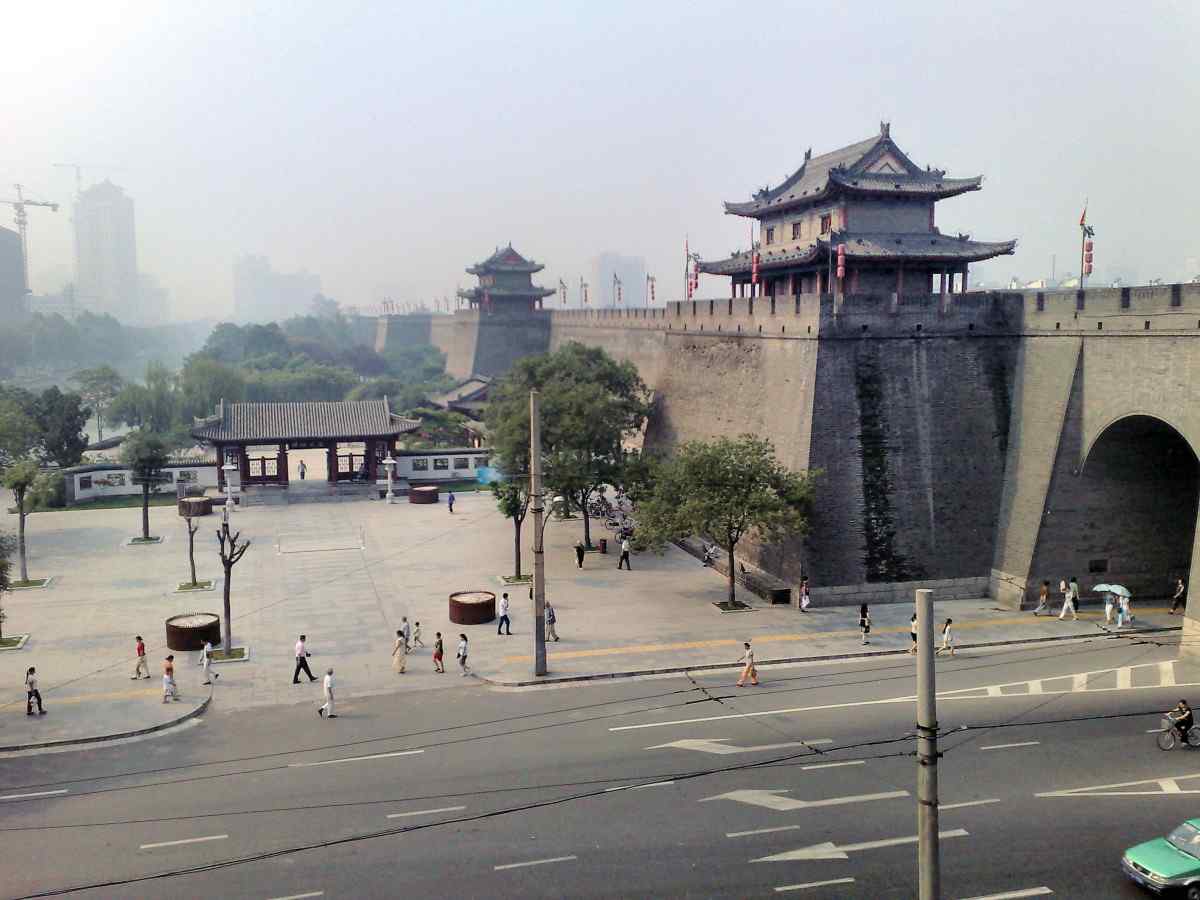
Walls of Xi’an
Visiting Xian
FABULOUS
Xi’an is a must see. I was doubtful about the importance of Xi’an. Of course, there are the warriors, but.. all that distance… for that…
WRONG!
The warriors for themselves sure deserve the trip, but Xi’an is much more than that. An harmonious town, where tradition and modernity stand side by side, without the strong contrasts of Shanghai or Beijing, for instance.
Visiting Xian is mandatory: Xi’an is an absolute MUST SEE.
Wild Goose Pagoda

Not exactly a simple temple, but a wide complex with temples, pagodas and gardens.
A detailed visit will take lots of time. If you don’t worry too much about the function and history of each construction, then a couple of hours will do, but be prepared to meander around, or you will take a rather basic idea of the whole.
The most impressive structure is the Giant (or Big) Wild Goose Pagoda, Also Dayan Pagoda, built in 652 during the Tang Dynasty, with materials brought from India. It was rebuilt in 704 during the reign of Empress Wu Zetian, with the exterior brick facade renovated during the Ming Dynasty.
In the complex many other things must be seen, specially the Da Cien temple, and the gardens, with many musical fountains and sculptures.

Monks


Be aware that, like everywhere else, temples are praying sites, and, despite their old and exotic look, they may keep being used for their religious purposes.
That is the case of the Wild Goose Pagoda, where we tried to do not disturb the praying monks, but… only their great concentration helped us.
Wild Goose Pagoda shops: Nice to See

Don’t skip the shopping area in the Wild Goose Pagoda.
More than a shop, it looks like a museum, and allows different angles to see the site.
The prices… well, that I skipped, but, being in a monument…!

Recuperation

That was mainly seen in Beijing, but also in Xi’an. Many monuments exhibit covered facades, but also there are works on-going with visitors around.
The Big Wild Goose Pagoda was no exception, but the disturbing to the visitors was minimum.

City Wall
A sense of strenght
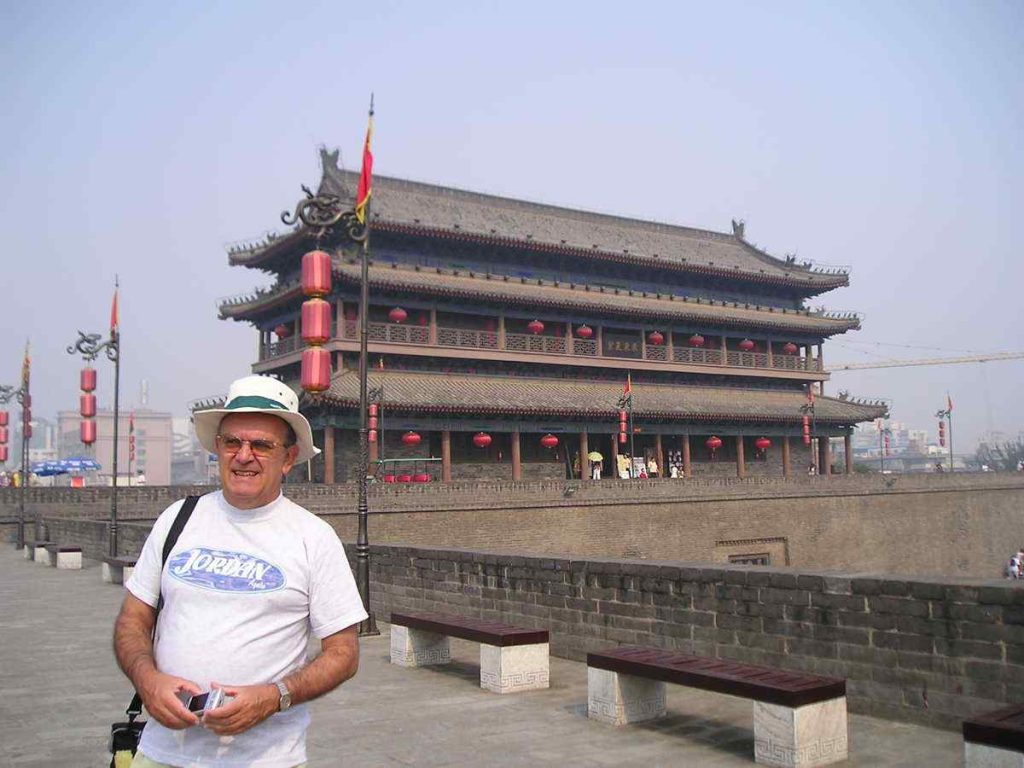
Visiting Xian it’s fundamental to climb the city wall, and to walk on it.
It’s easy to feel its importance in the defense of the city, and the challenge it would mean to those who tried to cross it with their primitive resources.
Though the balloons and some decoration are recent (I don’t know if matching any tradition), it’s remarkable the aesthetics they add to a military construction.
Perfect preservation
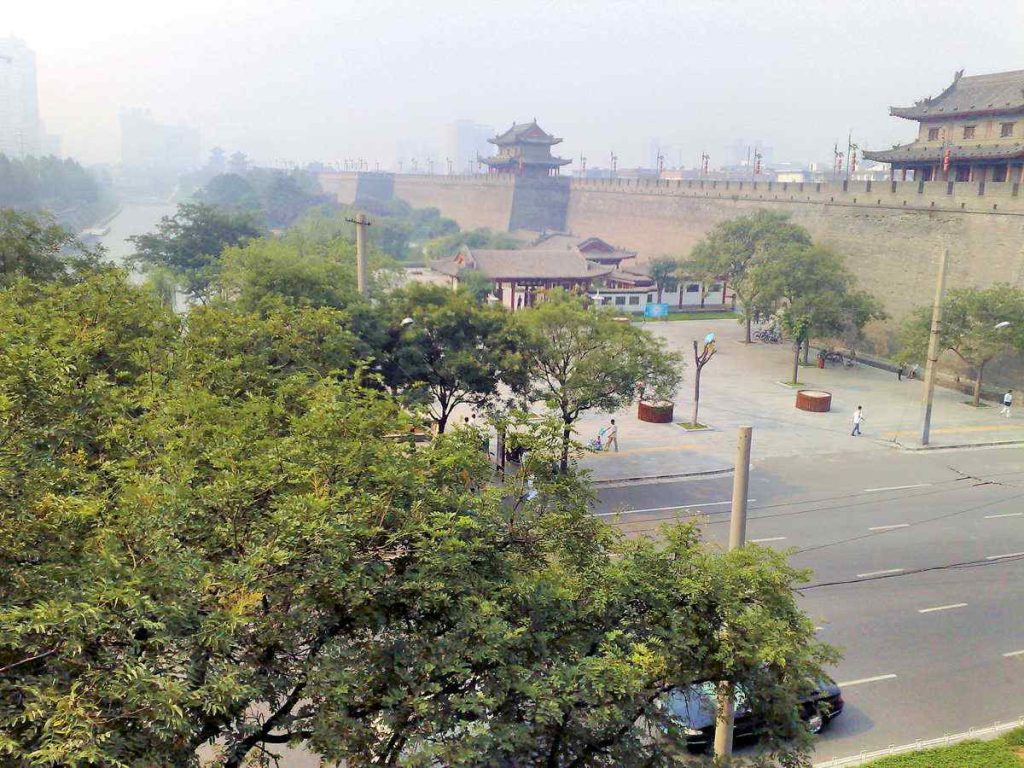
The construction from the Ming period was totally recovered in the eighties. Excellent idea and work. It expresses true authenticity, and the sights of the ramparts punctuated with beautiful towers until fading in the haze is magnificent.
Walking a little in any section of its 15 km long, and the visit of one of the several towers are not to be missed.
War Machines
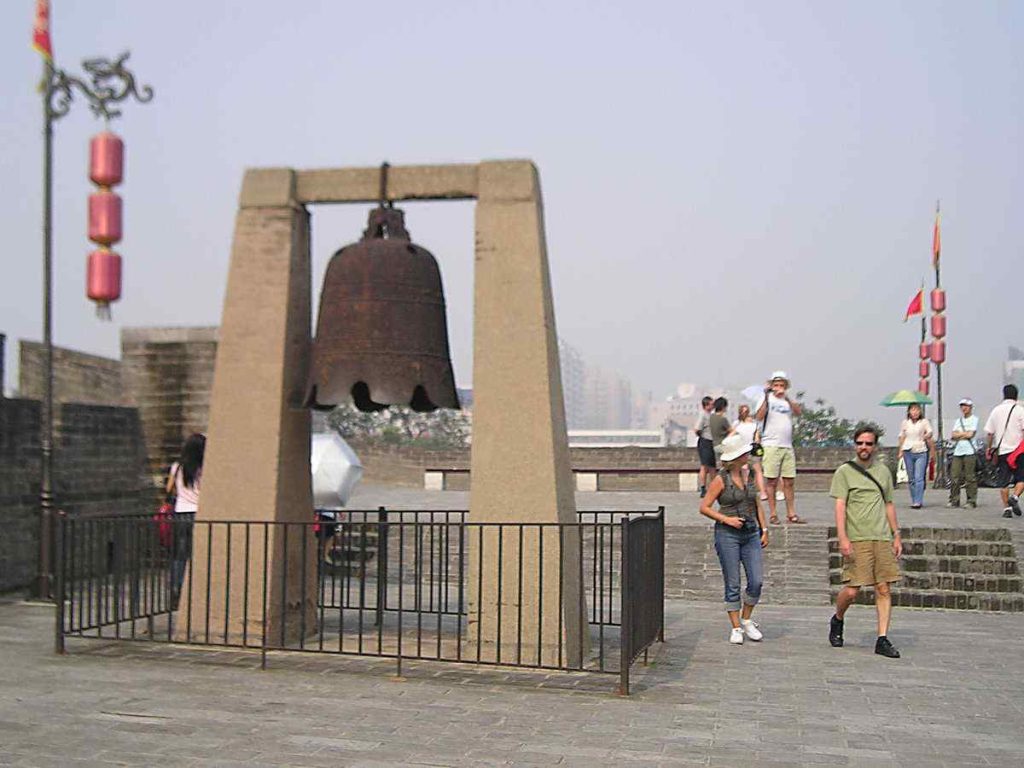
The city wall is a great monument by itself. Walking on it, even in a short distance, is mandatory.
Furthermore, the clever idea of spreading on it some recreations of the old war machines enhances the views, and give this place a sense of natural authenticity.
Of course, we don’t know the purpose of some of them, but… they fit well in place!
The Moat
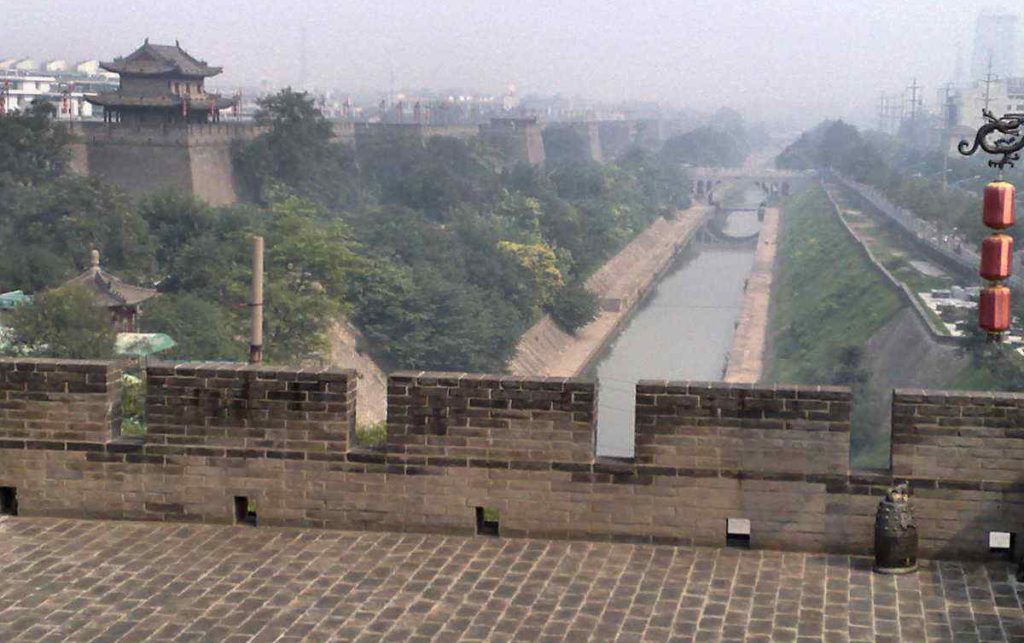
The big, solid volume of the walls make the long and wide moat that surrounds them look like a “insignificant” detail, but we are forced to admit that its perfect conception was an effective defense, and it helps today to enhance the views of the walls and the sensation of power that they emanate.
The External City
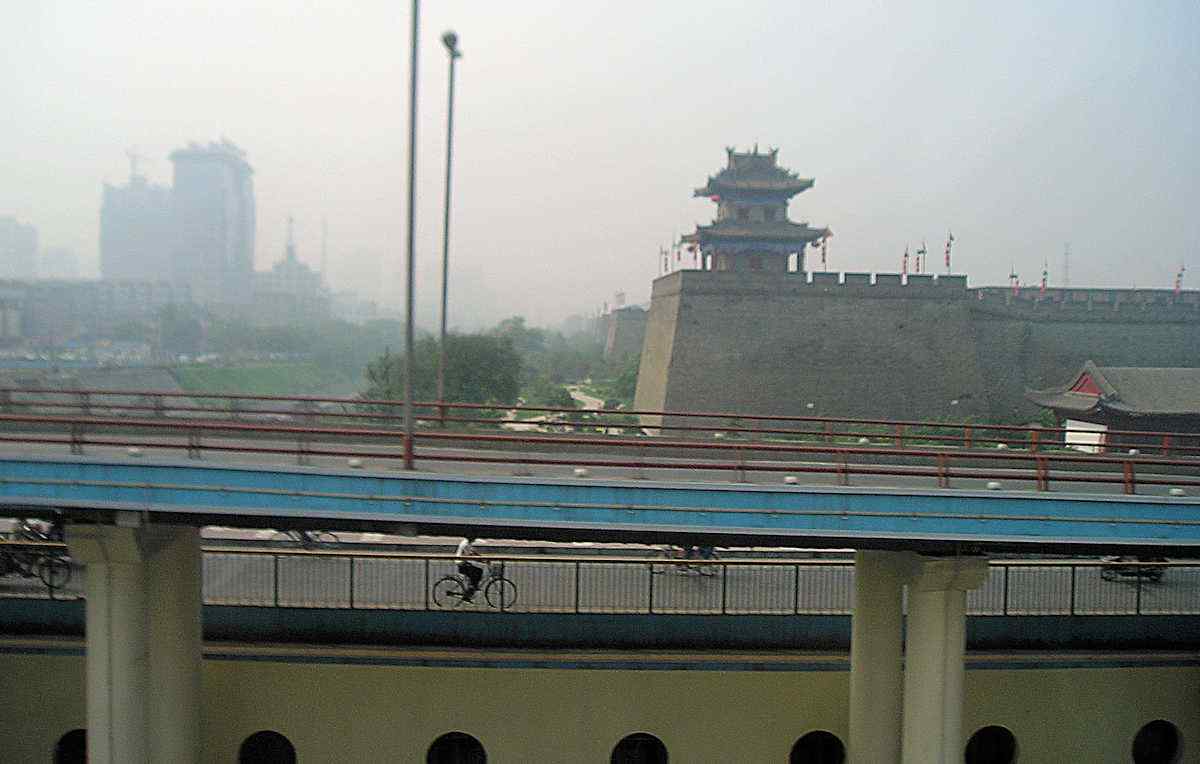
Around the huge area encircled by the walls, a modern city seems to match the development seen in the other big cities of China.
Concentrated in the interior of the old town, and the external highlights (terracotta warriors and tombs) we had no time to explore that part of the city, only having of it a general idea caught from the bus.
Saving time
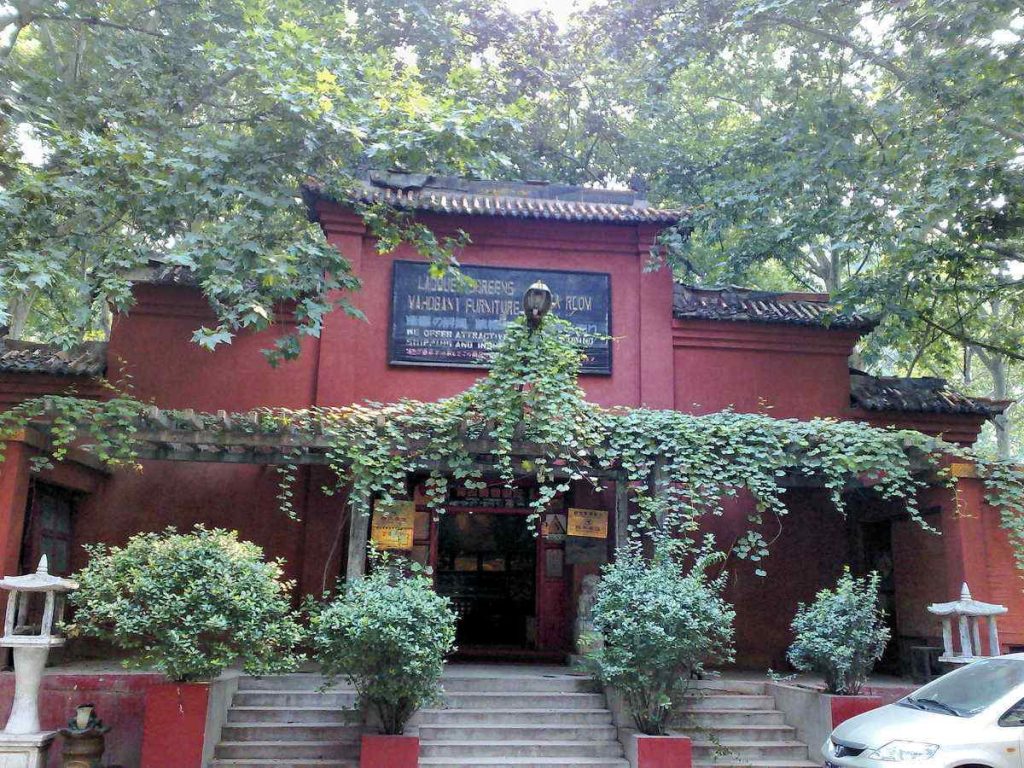
In your escorted tour, you have to be taken to factories. Can’t escape!
Accepting that, if you may choose, do pick something like this. The factory itself is an old place with a classical atmosphere and the separated ateliers show, at once, several arts, almost everything.
Of course, you need to check prices – I didn’t!
Bazaar – Muslim Quarters
The mosque
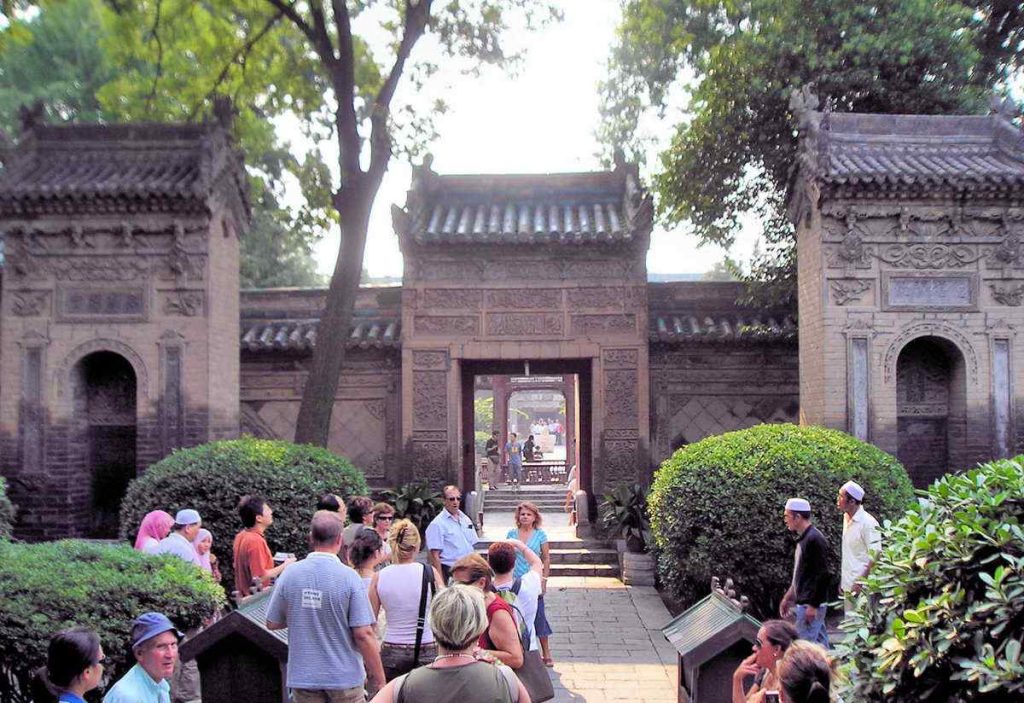
It’s quite a surprise this building. Everything looks… Chinese, in Ming style.
Without a warning, no one could imagine this site as a Muslim temple. A good exercise is to walk around, searching for signs that confirm the nature of the religious practices in place, and, discreet, they are there: In a shadowed room, the carpets oriented to Mecca wait for the prayers, and in the garden, some decorations are a Chinese interpretation of Arab decoration.
Funny!
Mosque – The garden
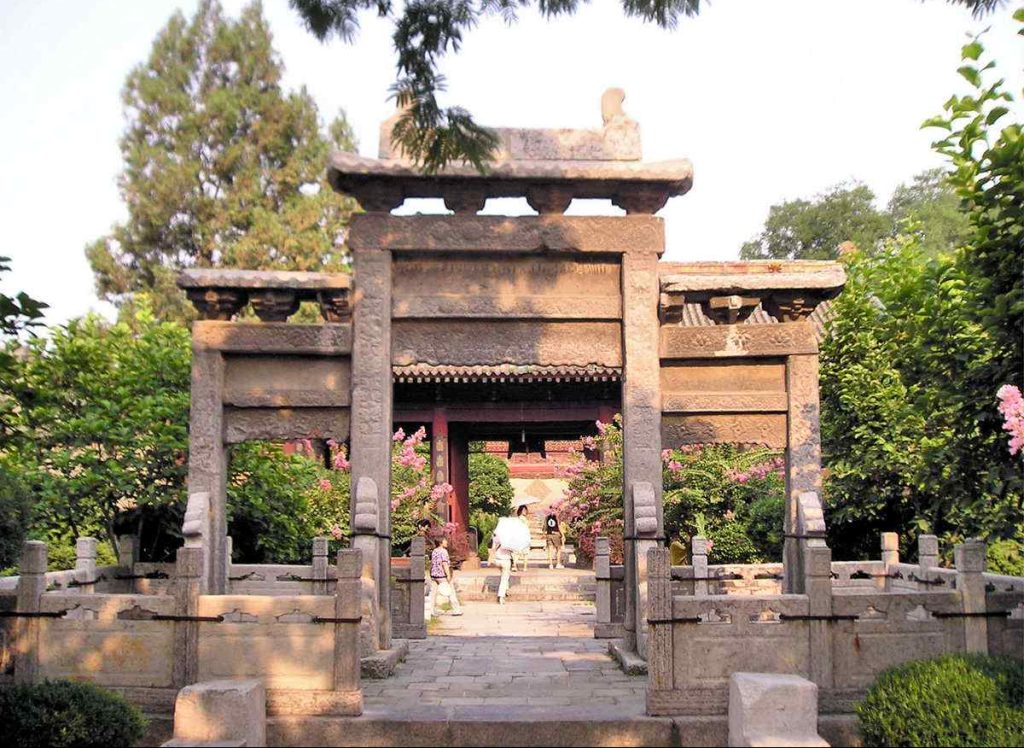
In almost all the mosques that I visited, water for purification waits the believers at the entrance, and receive a treatment of some evidence.
I didn’t see it in Xi’an. A beautiful and refreshing garden, but no fountain. They really wanted to be original, or did I miss something?
Muslim Quarter
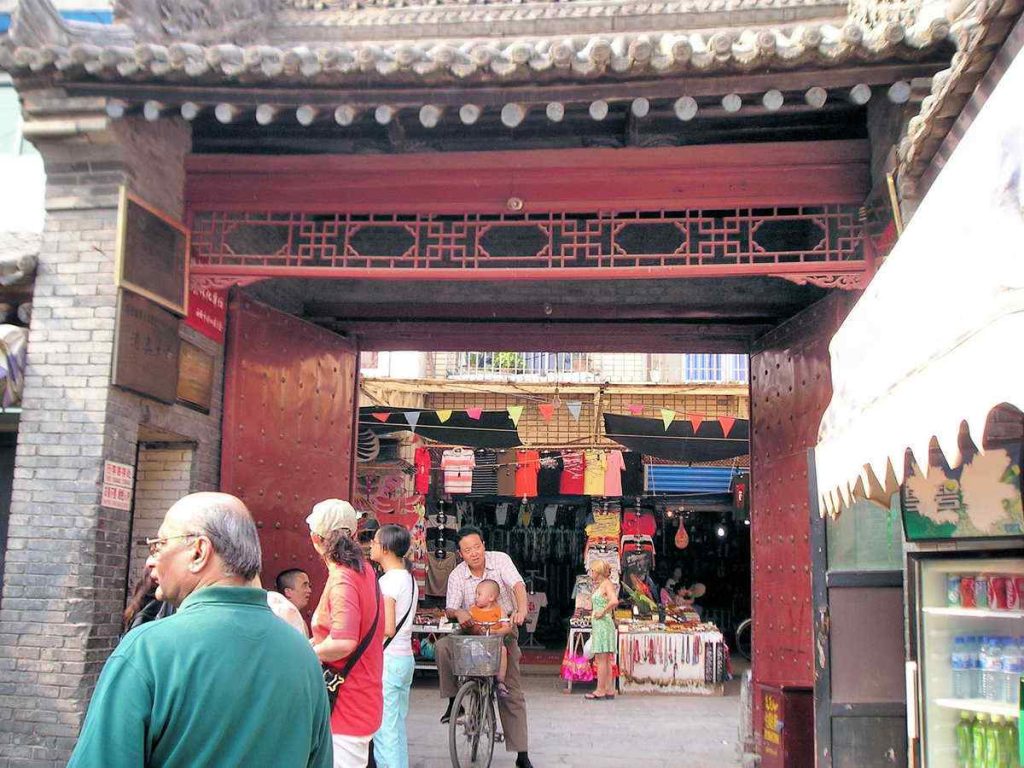
The mosque of Xi’an is a surprise, without many signs connecting to muslim art and architecture, however, when you exit, if you walk a little in the narrow streets, you will easily feel the muslim way of life around you.
Bazaar
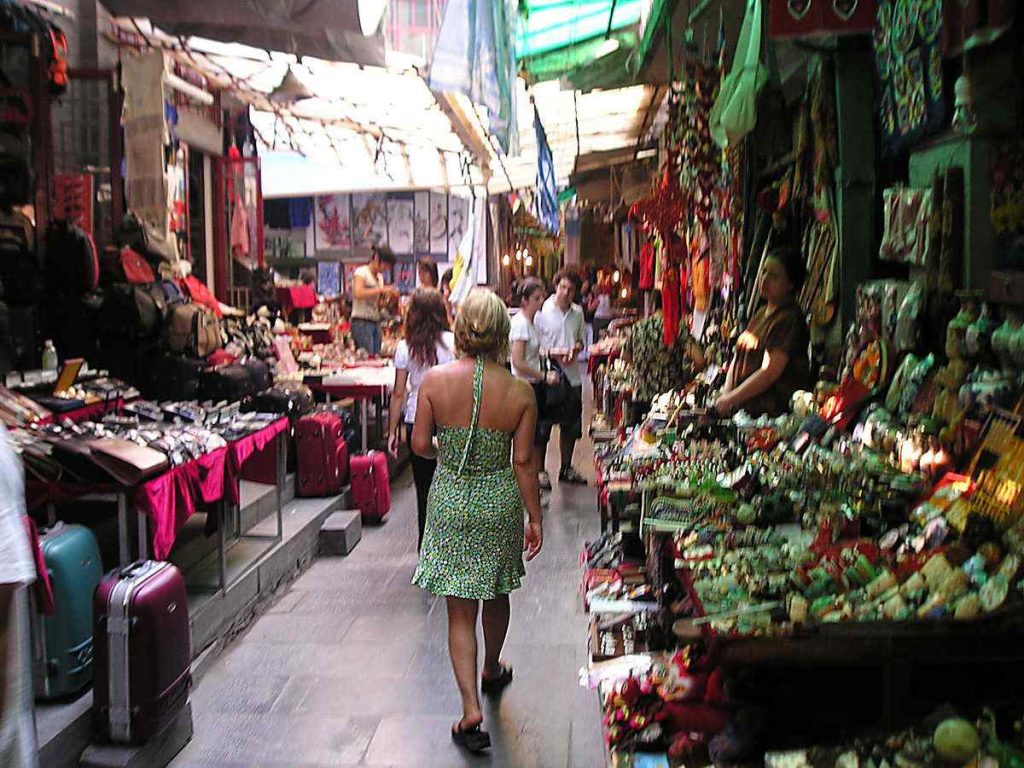
Take your time in this area. The bazaar is a wide area of stalls selling… everything, but around it, China pulses with its best colours and events.
The streets and walkways are full of life, and if you can support some unpleasant smells (Fernanda complained a little) it’s something you shouldn’t miss.
Birds
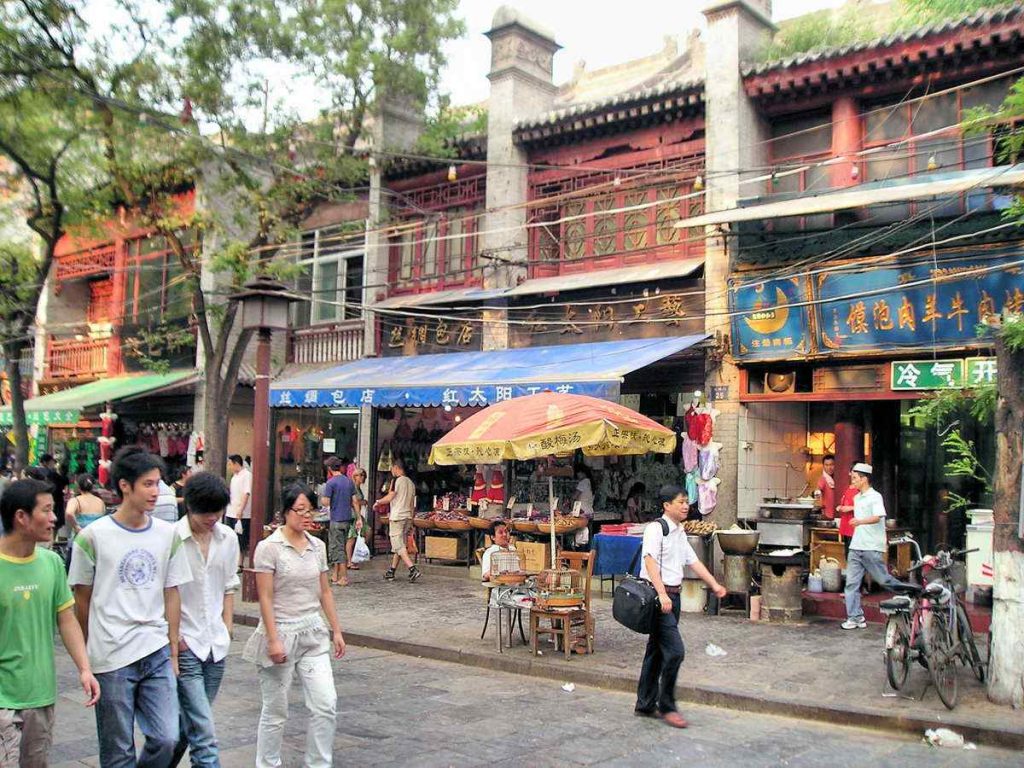
Maybe because of the excess of population (maybe because they eat them…) dogs and cats are not very visible in China, where pets seem to be mainly fishes and birds.
Birds deserve a special attention, with people taking them to the parks to “meet friends” and exchange melodies. Without surprise, selling birds is an important branch of local commerce.
Drum and Bell Tower
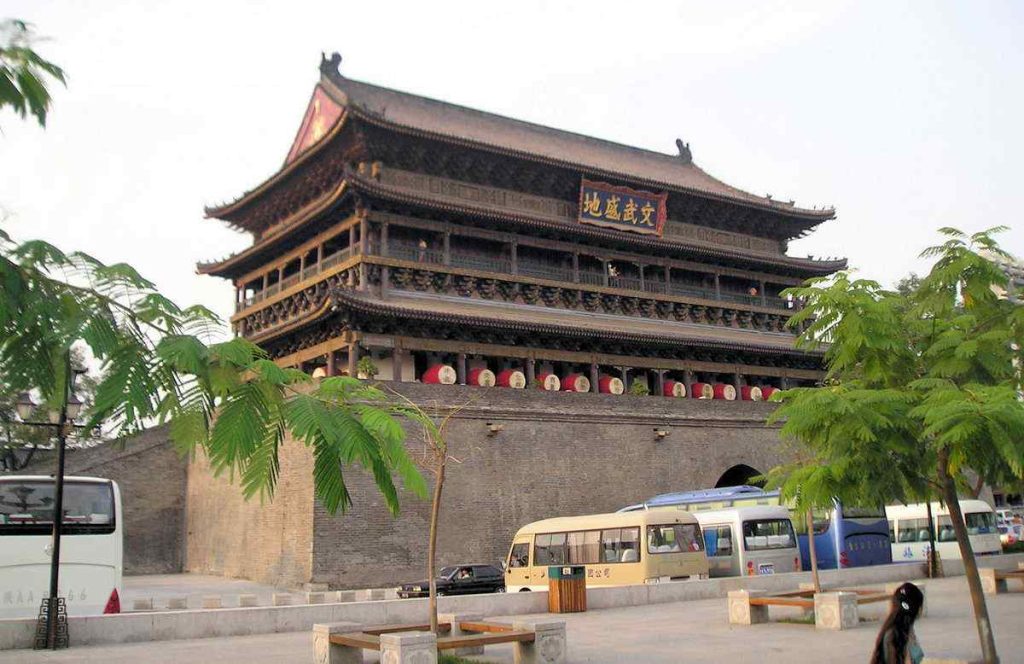
In the centre of the old city, and marking the entrance to the Muslim quarter, there is a beautiful tower, very similar to its neighbor – the Bell Tower.
The main difference is that instead of bells it has large drums all around it. We had no opportunity to assist a drum performance, but, no doubt, with that size and quantity it shall be a hell of a noise…
City Center
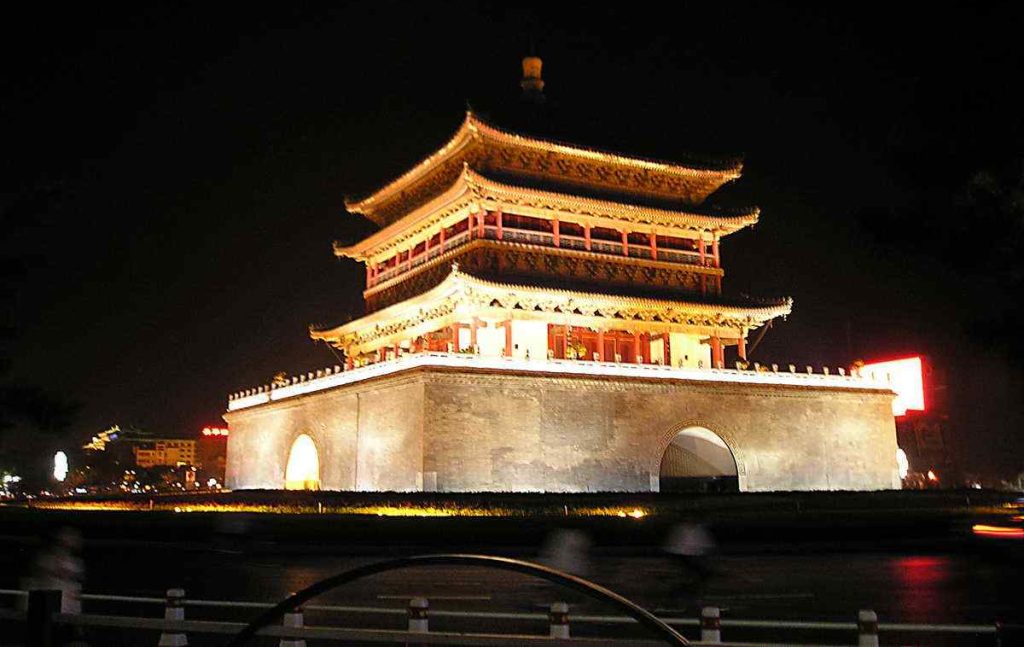
In many aspects, the bigger Chinese cities are getting an “American look”, given by architecture, space, lights, and organization.
One thing, fortunately they are not copying: the concept of town. Xi’an has something that almost all American cities miss: a centre. Nowhere I saw such a well defined centre: a square wall 15 km long defines the centre of town, and inside it two big avenues split the rectangle from north to south and east to west. Where they cross, a beautiful tower occupies the square. Perfect and wonderful geometry.
Tang Dinasty show
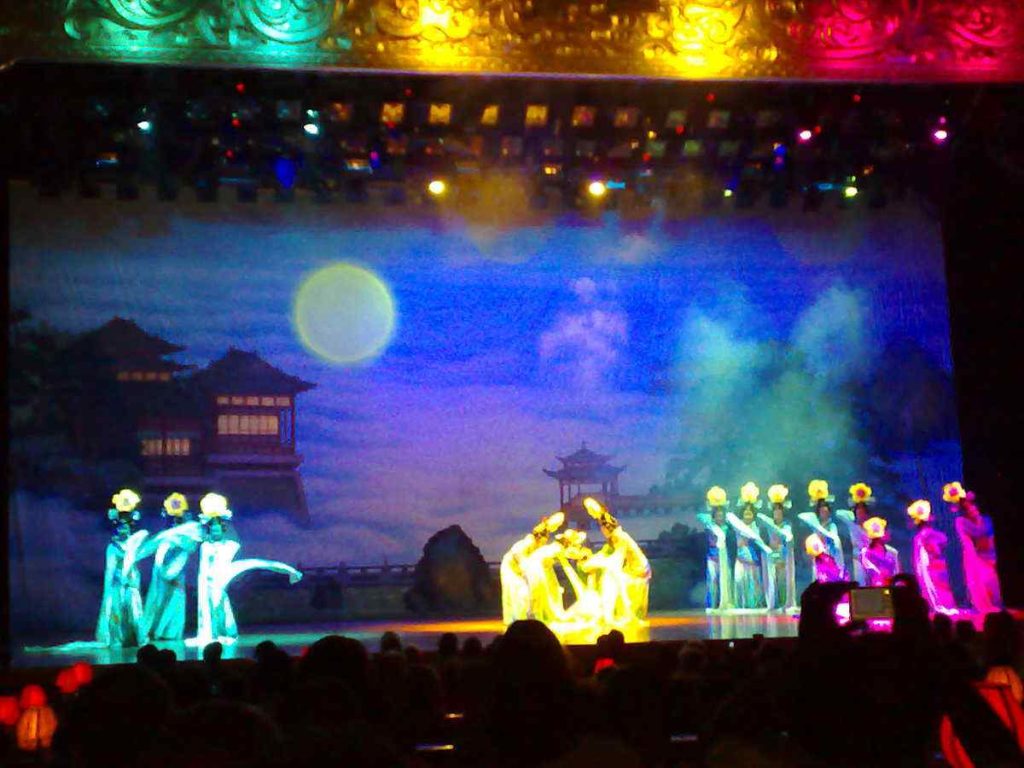
I mentioned this in a few places, but I have to do it again here: It is, really a “must do”, in Xi’an, to watch this magnificent show.
Your eyes and ears will thank you.
Address: 75 Changan Road
The terracotta warriors
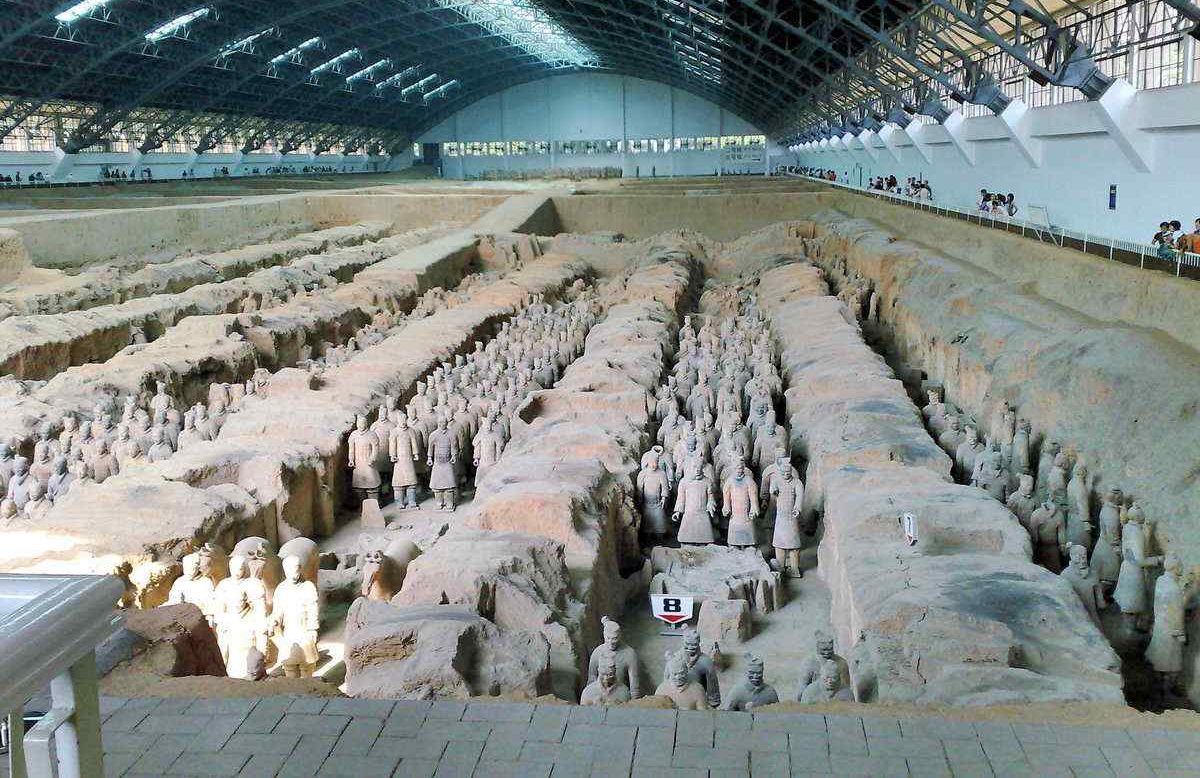
A very well-conceived 360º film explains how did time lead to the actual situation: the construction, the destruction by the Mongols, the recent discovery. It is, really, enough reason to visit Xi’an.
Colors
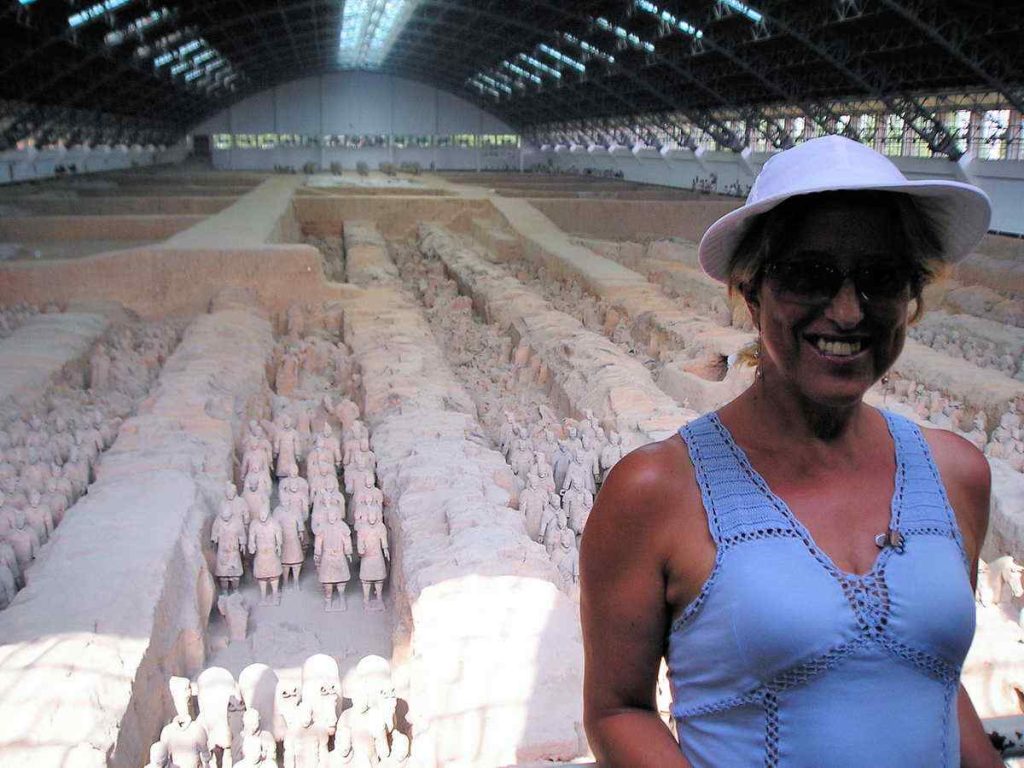
When the terracotta figures are dug, they show almost the original colors, but, in contact with the air, the colors rapidly fade and disappear. That’s why they stopped digging, even returning some figures back to the earth.
In the universities they are studying the best way to preserve the colors and only after that the work to unearth an reconstruct the figures will proceed.
Meanwhile, there are hundreds to see, but… almost colorless!
Pit 3
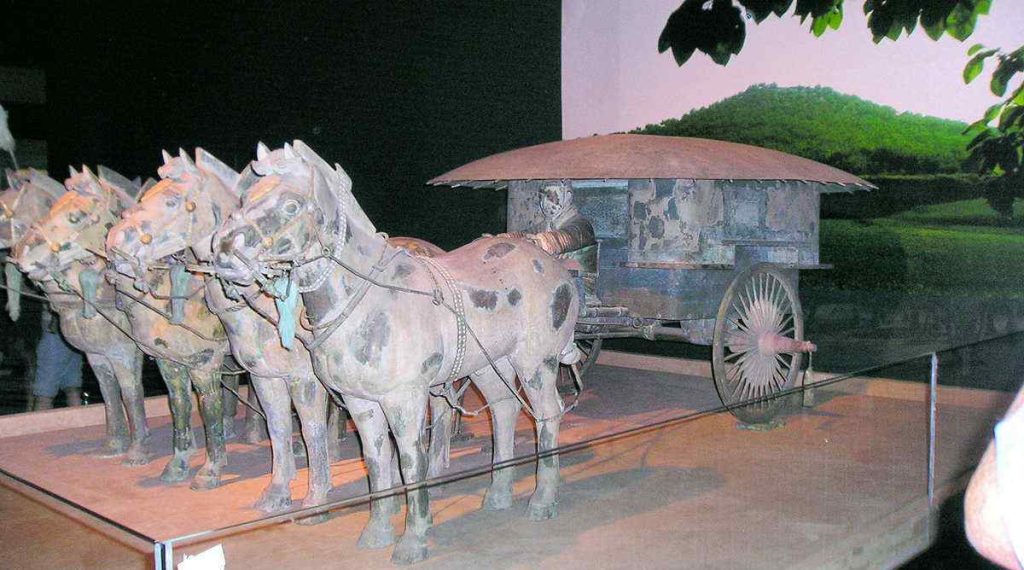
We enter pit 1, the larger one, and we get immediately the notion of the huge size of the archaeological site, but they alert us that only a small part is dug, and that the main open area is pit 3. Why?
Because it is the headquarters. Generals, nobles and other important people seem to be represented there. Well, maybe historically that is important, but for the general visitor like us nothing beats the impact of the immense pit 1.
360º Movies
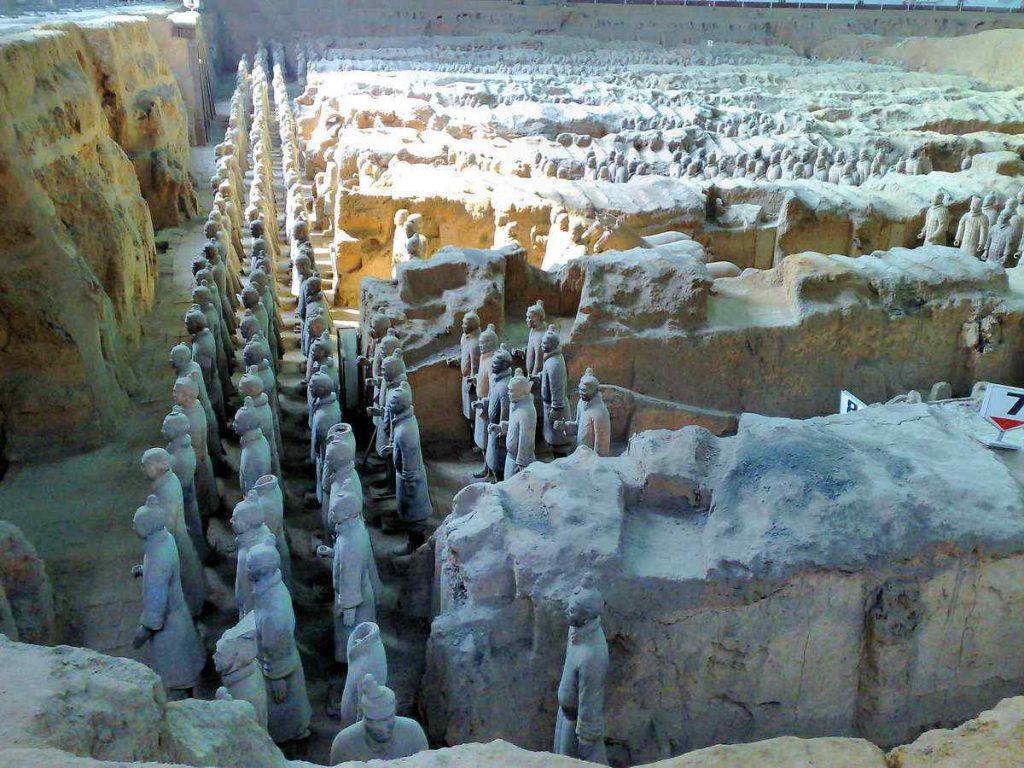
Well done, this explanatory film, explaining the construction of the statues and their destruction by the mongols.
The synthesis is perfect, and we really feel in the middle of the action.
Twenty quick minutes that you shouldn’t miss, at no extra charge.
Hanyangling Museum
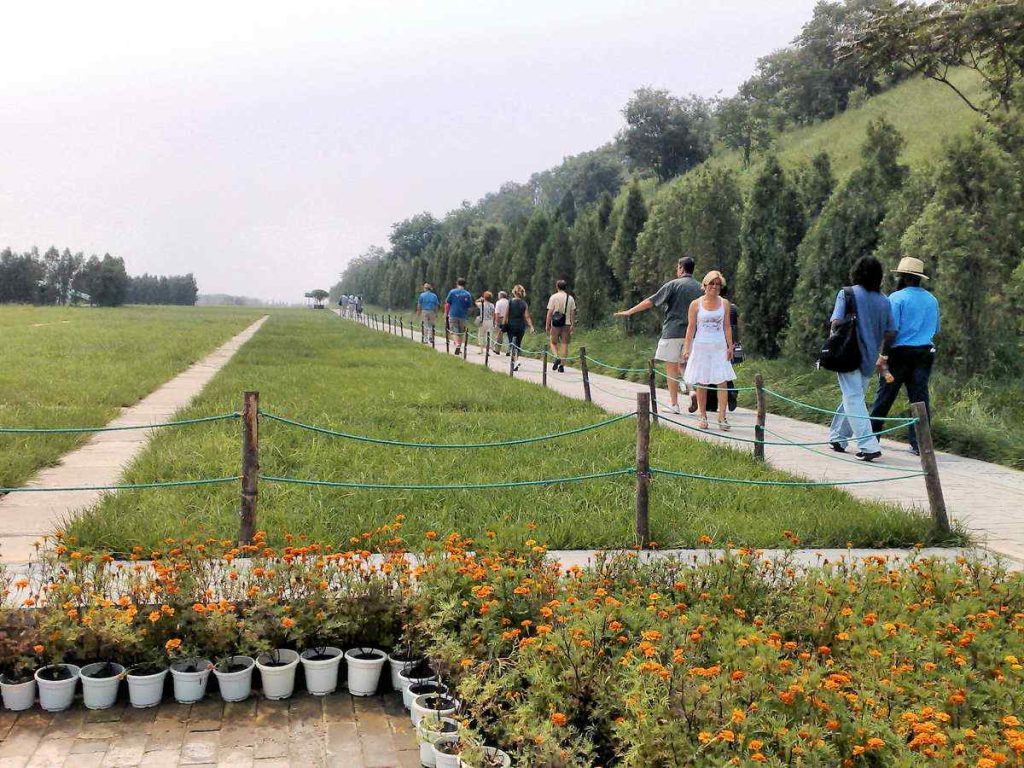
This museum is a grave. The dug mausoleum of Emperor Liu Qi is fundamental to understand the more outstanding terracotta warriors.
In the dark corridors, we can see lots of small dolls, buried with the emperor, and, according to the tradition, representing people to serve him.
The small step from dolls to actual size figures was only a matter of power and ambition.
A Small Collection
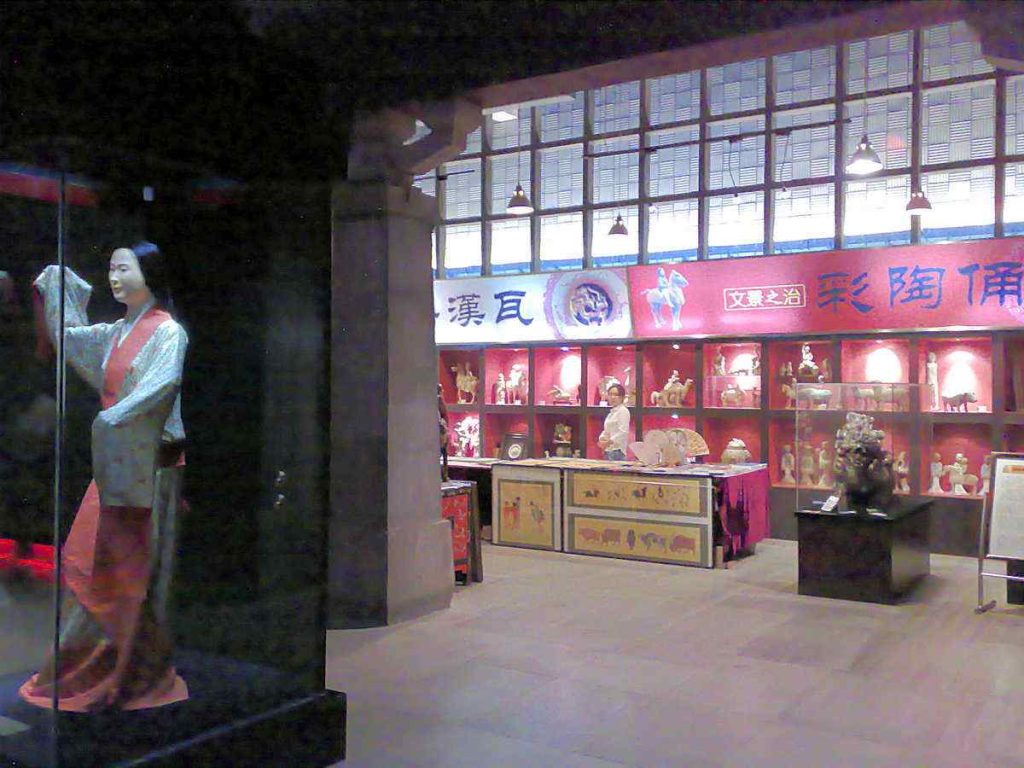
There is not a large collection in this museum, but the wide space, under dimmed light, is very well planned and presented. So, you must be aware that the real collection is displayed in the many pits that surround the emperor’s tomb.
Getting back to light, you’ll meet… a shop, of course.
A challenge
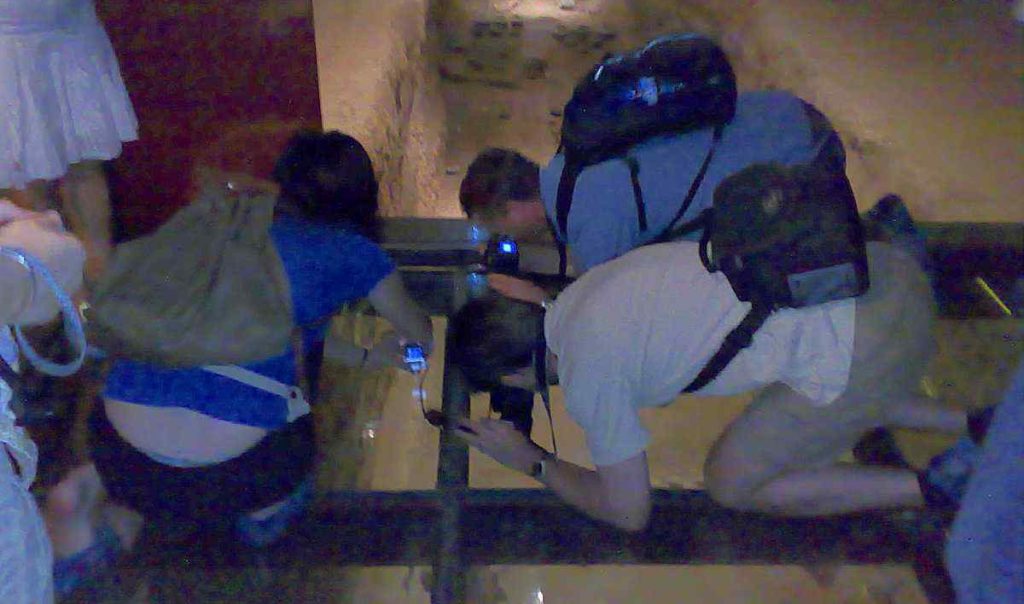
What a challenge for the photo maniacs!
The poor illumination, the reflexes in the glass, the impossibility to use flash, the uncomfortable position, everything contributes to the poor quality of all the taken pictures.
Of course, some efforts deserve respect!
Crowds
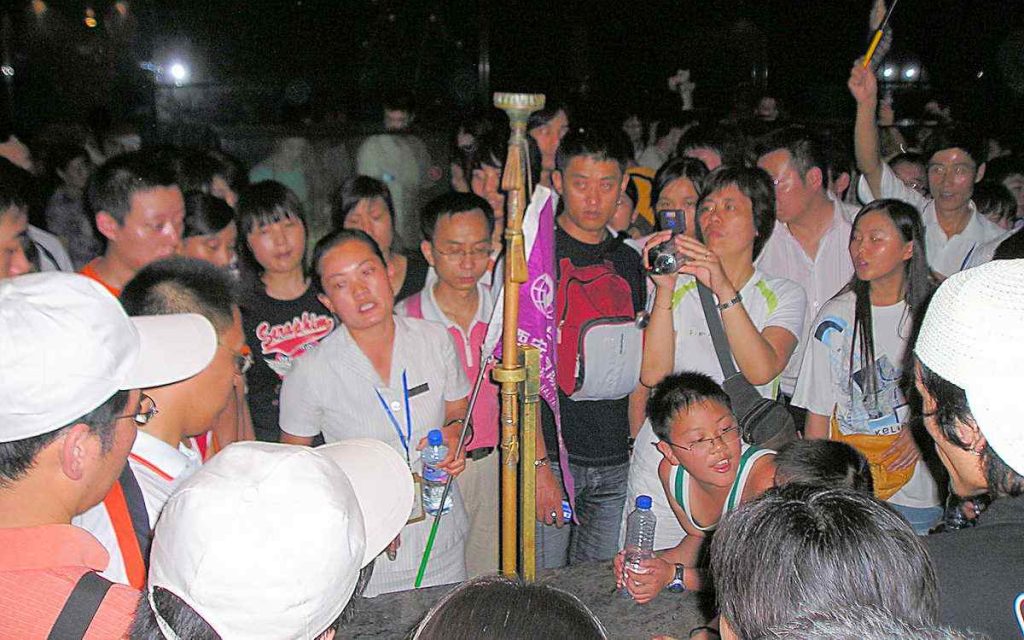
Taking a picture of a detail is something hard to do, unless you use the tactic of holding your camera in the air and taking the picture above dozens of heads.
In the display by the terracotta warriors I did it, getting a reasonable picture of something that… I couldn’t see.
When, finally, the crowds allowed a short break I noticed that it was a sword. But all the large stories around it were… in Chinese, so, I couldn’t find out why was it so important for them, and that allows me to use the imagination: it was the emperor’s sword.
Glass pavements
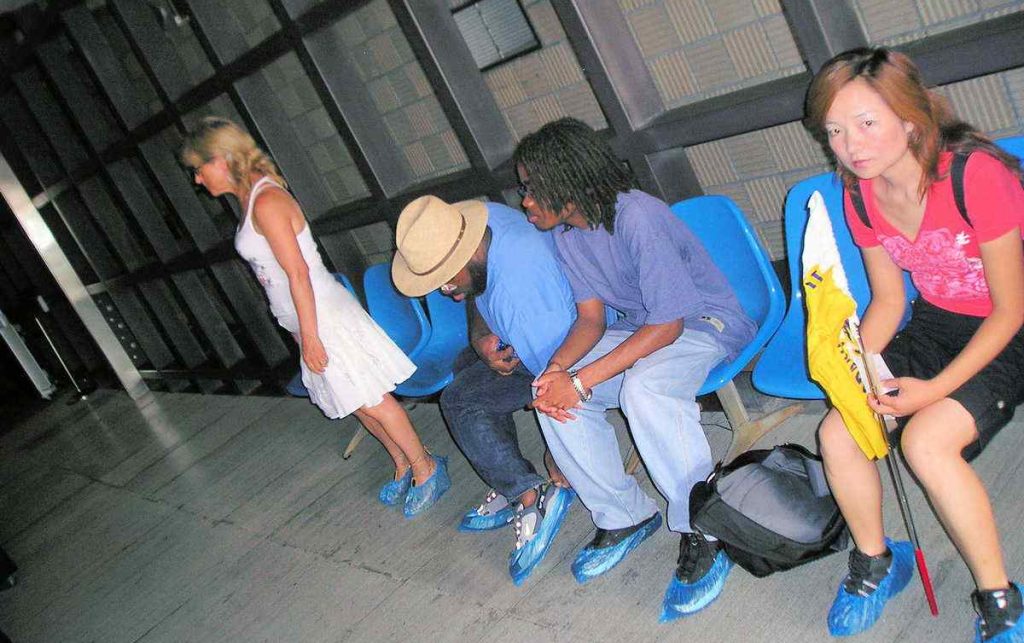
The excavation area is seen from above, walking on a glass pavement.
To avoid scratches in the glass, everybody receives a couple of plastic bags to cover the shoes.
Clever, but the surprise of the situation is a good opportunity for some laughing, and some shoes are hard to cover.
“Bottoms up”, then, will be the common position to see the Museum… for those who do risk.
Provincial History Museum
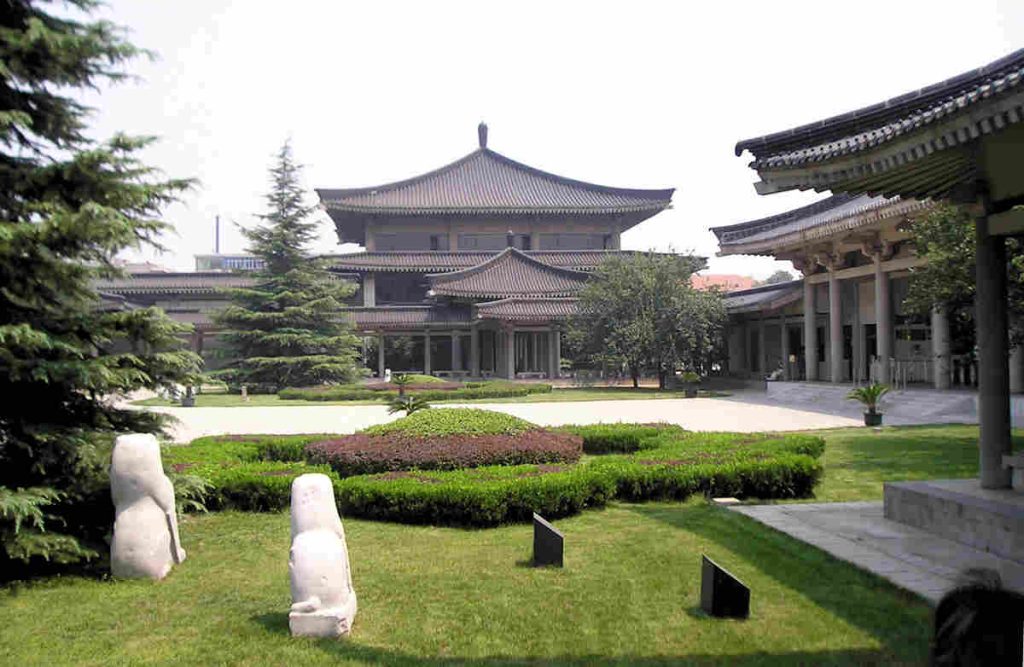
The terracotta warriors have the expected evidence in Xi’an’s Provincial Museum. They are simple details that will not replace the visit of the excavations site.
For those who had been there, the display doesn’t add much in that subject, however, there are other topics deserving to be visited.
Ceramics


Ceramics and porcelain are some of the most distinguished arts in China. Though mainly concentrated in the older days, the collection of Provincial Museum is very rich, showing very uncommon pieces and techniques… at least for a non-expert as me!
Personal Memories
 Personal Memories
Perfect night – Tang Dynasty show
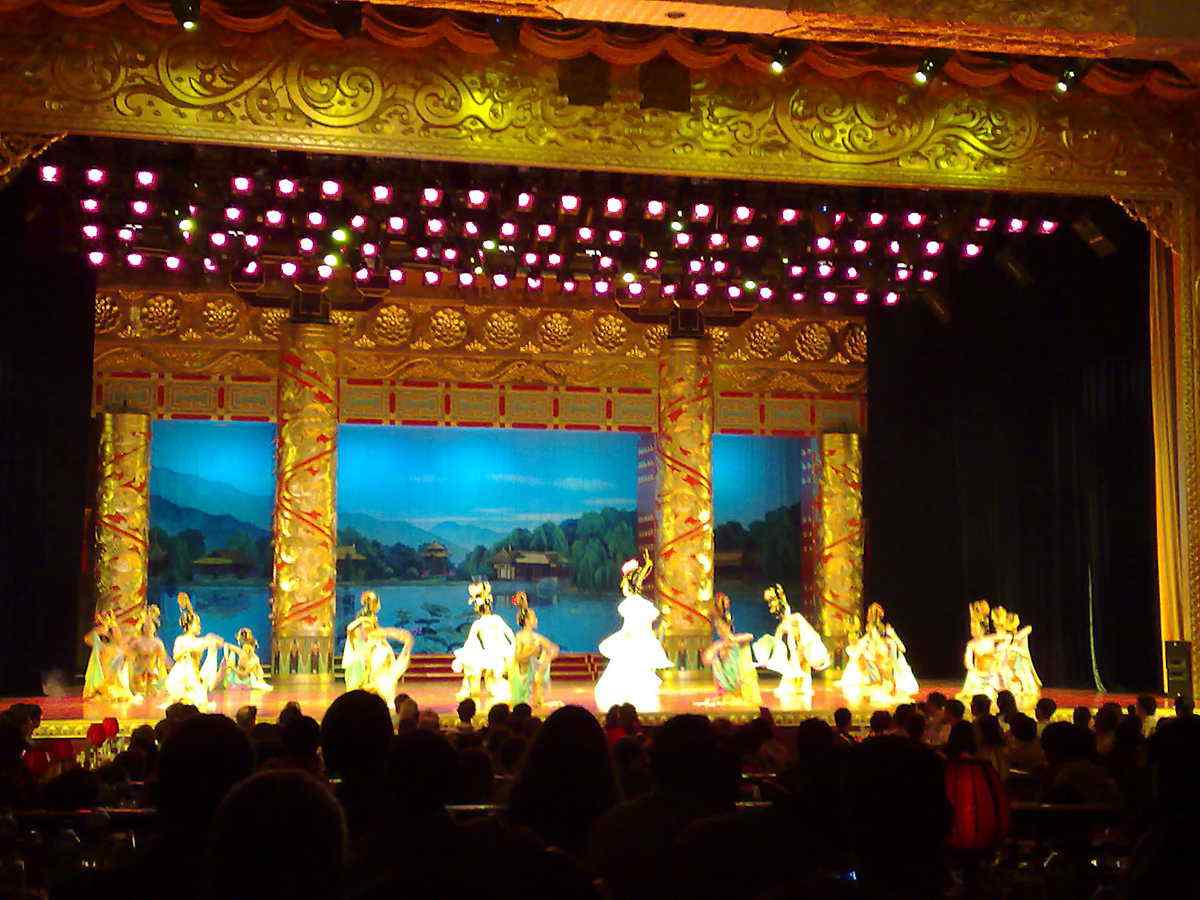

The strongest memories of Xi’an force me to say:
Put this in mind:
If you go to Xi’an and miss this superb show, I will not talk to you anymore!
Address: Tang Dynasty palace, 39 Changan Road – Xian
A Personal privilege

The room is large and beautiful. People sit around tables, in a mix of theatre and restaurant that announces noise and movements during the show.
Imagine that, reading the list, you state: Port wine. It can’t be serious!
Being Portuguese, of course I tried to laugh about the thing, investigating what the hell they call “Port wine”. Can you imagine?
Well, it was… Port wine. Portuguese. True and honest!
A good company for a noisy and agitated show, I thought.
WRONG!
Eating drinking and talking was BEFORE the show. When it started, the silence was respectful, and we could enjoy each detail, including the nice set of musician ladies in a box, the colors, the dances, the music, the Port…
Flowers
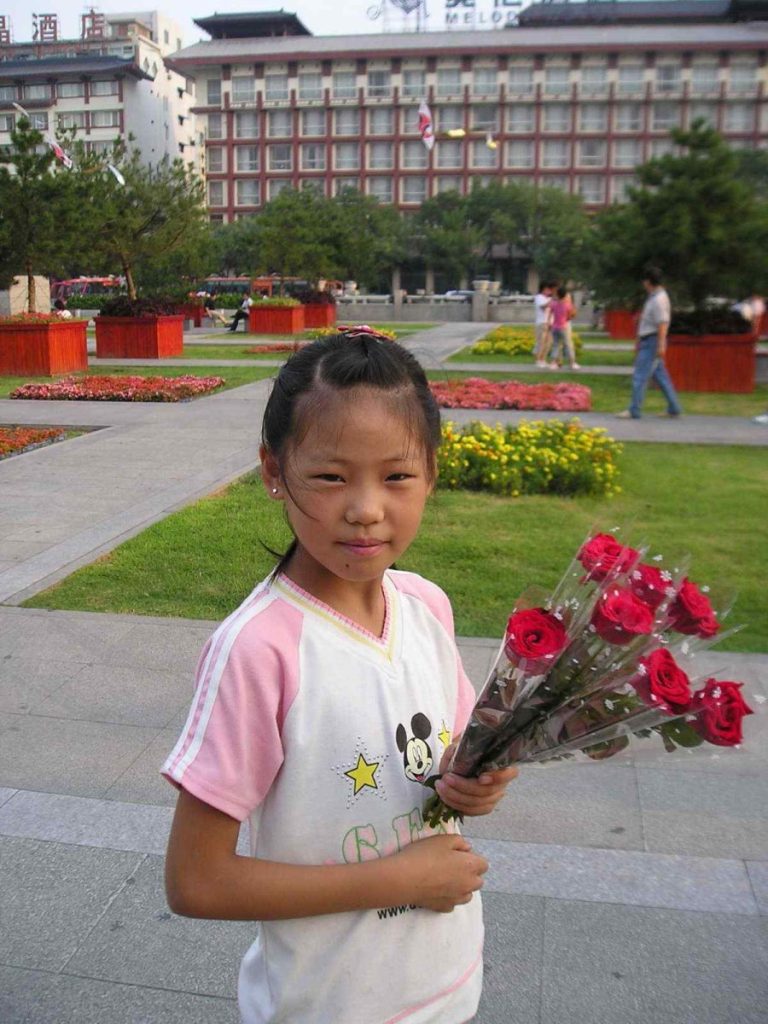
“No need to pay!”
Where did this small girl learn this English, how does she know that, of course, accepting the flower that she gently offered me I had to offer her back… some generous RMB?
Is this already a sophisticated selling technique? A part of a scholar program?
“Thanks dear girl! I will offer it to my wife!”

Discipline
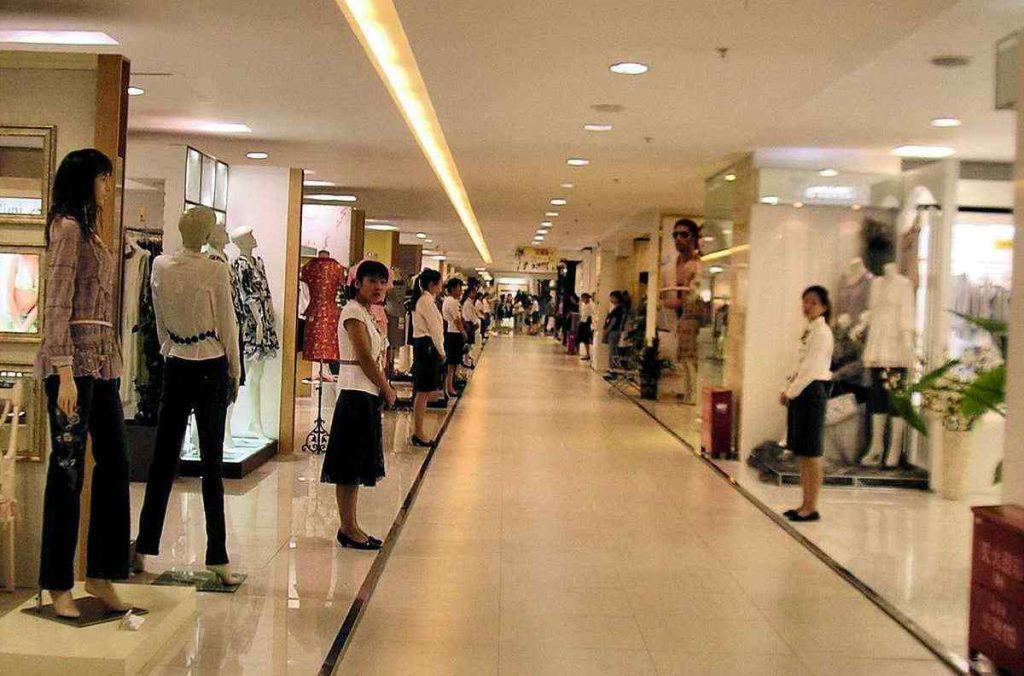
One thing that I noticed is the rigour used by the workers in their jobs: In shops, restaurants, everywhere, the staff lines the corridors, occupying predetermined places, and standing rigid until a client needs their service.
In a long and empty store (yes, it happens also), sometimes, it looks like a handsome military parade.
One of the 3753 shops I had to enter: Language is no Barrier

On the 14th day of August 2007, it took place in Xi’an an extraordinary assembly of the Women International Organization in China, with the following plan of work:
1 – A pair of pants
After 6 hours of useful discussion, it was possible to reach an agreement, approved by 64% of the votes. The final document will be written in the next weeks and translated to “Poltuguese”.
Note: The meeting was not open to the public, so the only possible image was taken by a Portuguese paparazzo.
Merchandising
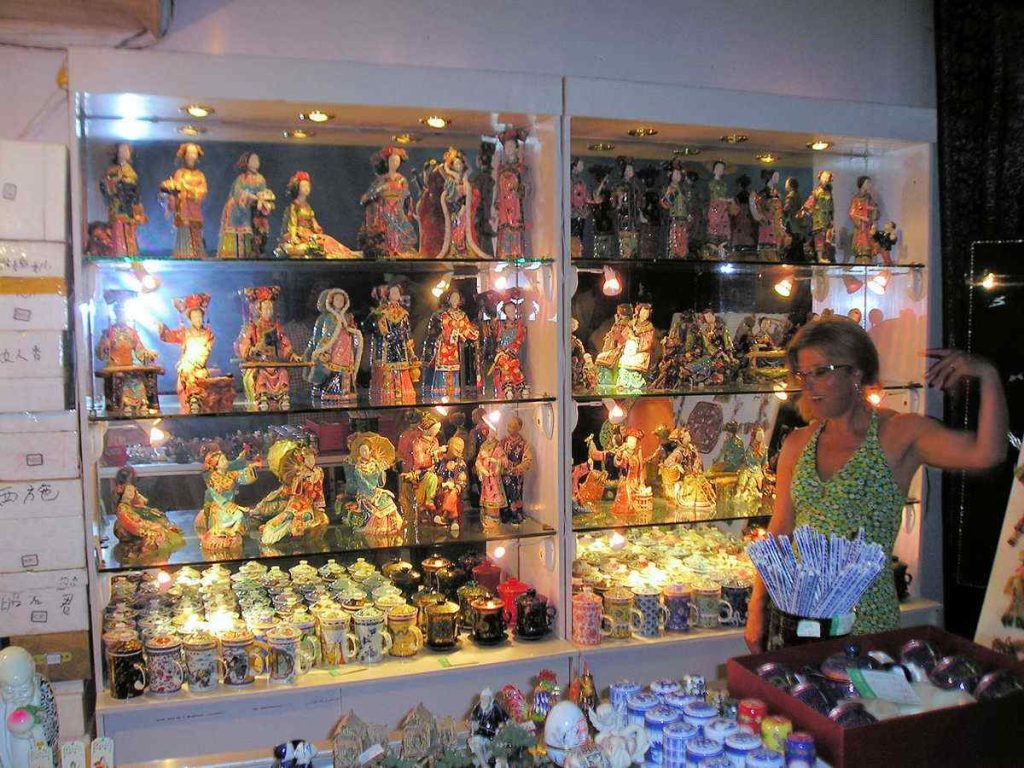
China bets in tourism, and the museum of Xi’an is a good sign of it.
Modern and functional building, with merchandising dominating all entrances and meeting points.
The prices… well, the prices… (Follow the example of an English member of our group that bought several things for less than half of the demanded price: show some dollar bills, and… bargain, bargain, bargain…)
Good choice
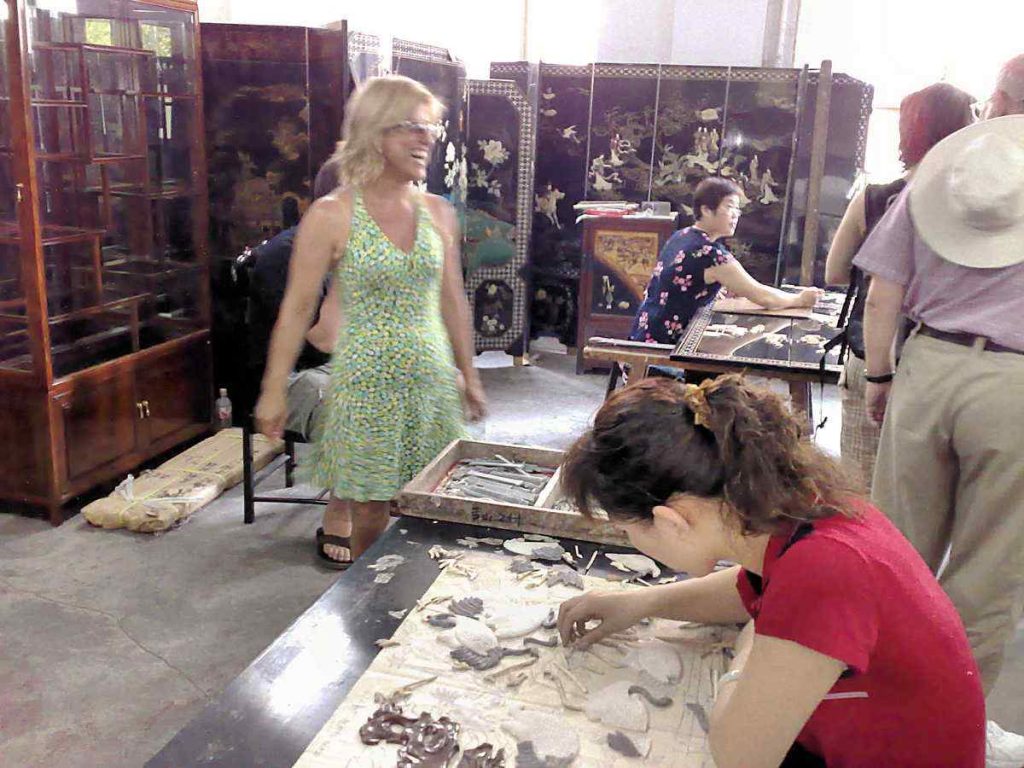
One of the worst aspects of many escorted tours is shopping. We are always taken to selected (pricey) places where the guides expect to collect their commissions.
In many cases the time devoted to commission collecting equals the time to all the other planned visits.
Travelchinaguide was good.
They respected the obligation of taking us to see the artisans at work (and that is also important in tourism), but they didn’t exaggerate. The visited places were selected, we covered everything that should be seen, but never felt dragged into shops. This factory in Xi’an was a good example. Several techniques demonstrated, sympathy in all the explanations, but no one was pushed to buy whatsoever.

Eating in Xian – 1 excellent mixture
Sleeping in Xian – 2 hard nights
Sleeping in Xian – 2 hard nights
Transports in Xian – 1 quick and positive idea
Shopping in Xian – 1 good and complete place
Plan your visit

Discover more with Touristrips
Welcome to Xian!
Xian, also written Xi'an, is one of China’s most historically significant cities, known as the eastern starting point of the Silk Road and home to the world‑famous Terracotta Army. The city blends ancient…
Plan your visit
Share your own experience
If you want to easily publish your own experiences, after registering you may use the form below. It will be added after revision. You may use text, photos till 20Mb or video. For a more complex publication click here.
Publishing form
You need to be logged in to view this page
Your trip will be perfect with the help of our partners
For a great experience:
For your safety:
For your comfort:
For cheap flights:
For local displacements:
 English
 Português