

Overview
Morocco is a fascinating North African country where Arab, Berber, African, and Mediterranean influences blend to create one of the world’s most diverse travel destinations. Bordered by the Atlantic Ocean, the Mediterranean Sea, the Atlas Mountains, and the Sahara Desert, Morocco offers an extraordinary variety of landscapes, cultures, and experiences. Visitors can explore imperial cities, ancient medinas, mountain villages, coastal towns, and vast desert dunes within a single journey. [visitmorocco.com], [visitmorocco.com]
Best Time to Visit
The best months to visit Morocco are March to May and September to November, when temperatures are generally comfortable across most of the country.
Spring is ideal for exploring the Atlas Mountains and Imperial Cities, while autumn offers excellent conditions for visiting the Sahara Desert and coastal regions. Summer can be very hot inland, while winters are mild along the coast but colder in mountain areas.
Getting Around
Morocco has a well-developed transport network connecting major destinations.
Visitors can use:
- High-speed trains
- Regional trains
- Intercity buses
- Domestic flights
- Rental cars
- Private excursions
- Taxis
The train network is particularly useful for travelling between Casablanca, Rabat, Tangier, Marrakech, and Fes.
Safety and Local Etiquette
Morocco is generally a safe and welcoming destination. Normal precautions are sufficient in most tourist areas.
Visitors should:
- Dress respectfully, especially in rural and religious areas.
- Ask permission before photographing people.
- Respect local customs and traditions.
- Negotiate prices politely in traditional markets.
- Respect religious sites and local communities.
Food and Water
Many visitors prefer bottled water, although treated water is widely available in larger cities and hotels.
Morocco is famous for:
- Tagine
- Couscous
- Pastilla
- Harira soup
- Mint tea
- Fresh seafood
- Moroccan pastries
The country’s cuisine is considered one of the richest and most diverse in the Mediterranean world.
Day Trips and Excursions
- Marrakech — famous for its medina, palaces, gardens, and Jemaa el-Fnaa square.
- Fes — home to one of the world’s largest medieval urban centres.
- Chefchaouen — the famous blue-painted mountain town.
- Essaouira — a charming Atlantic coastal city with a historic medina.
- Casablanca — Morocco’s largest city and home to the Hassan II Mosque.
- Merzouga — gateway to the Sahara Desert and the Erg Chebbi dunes.
- Atlas Mountains — renowned for hiking, Berber culture, and dramatic scenery.
Essence of Morocco
Morocco is a land of contrasts where bustling medieval souks, magnificent palaces, mountain landscapes, coastal towns, and vast desert expanses coexist. Its rich cultural heritage, legendary hospitality, remarkable architecture, and extraordinary geographical diversity make it one of the most rewarding destinations in Africa and the Mediterranean region.
Highlights in Morocco
The main highlights include the Medina of Marrakech, the historic centres of Fes and Meknes, the blue streets of Chefchaouen, the spectacular Hassan II Mosque in Casablanca, the Sahara Desert, the Atlas Mountains, the coastal town of Essaouira, the ancient Roman ruins of Volubilis, and the traditional kasbahs that dot the country’s southern landscapes.
Visited places:




- Morocco’s official languages are Arabic and Amazigh (Berber), while French is widely used.
- The country is famous for its historic medinas, souks, kasbahs, and traditional craftsmanship.
- Morocco offers Atlantic beaches, Mediterranean coastlines, mountain ranges, and Sahara Desert landscapes.
- Many visitors prefer bottled water, particularly outside major tourist areas.
- The local currency is the Moroccan Dirham (MAD).
- Mint tea is considered Morocco’s traditional national drink.
- Fes, Marrakech, Meknes, and Rabat are known as Morocco’s Imperial Cities.
- The Atlas Mountains divide the country between the coast and desert regions.
- Credit cards are widely accepted in larger cities and hotels, although cash is useful in markets and smaller towns.
- Morocco is well known for traditional crafts such as carpets, ceramics, leather goods, and metalwork.
- The country receives visitors throughout the year thanks to its varied climates and landscapes.
- Respect local customs, religious traditions, and cultural heritage when visiting.
aMorocco enjoys a variety of climates due to its geographical diversity. [visitmorocco.com], [visitmorocco.com]
- Spring (March to May) — mild temperatures and excellent conditions throughout most of the country.
- Summer (June to August) — hot inland temperatures, often exceeding 35°C, while coastal regions remain more moderate. [visitmorocco.com]
- Autumn (September to November) — comfortable weather and ideal conditions for exploring cities, mountains, and deserts.
- Winter (December to February) — mild conditions along the coast, cooler temperatures inland, and snowfall in the Atlas Mountains. [visitmorocco.com]
The country’s diverse geography allows for year-round travel opportunities.
Today:


Entering Morocco in 1982 by land, from Ceuta was a nightmare, almost convincing us to give up. The confusion at the border and the pressure of the touts trying to squeeze the tourists right from their entrance, was awful.
Arriving in Tetouan a gentleman helped us to find a good restaurant, and explained everything we needed to have a good trip. And we had. Fes was a striking experience, the visit of the medina beyond all the possible words.
Meknes, interesting, didn’t add much, Rabat showed modernity well combined with tradition, and Casablanca almost European didn’t convince me.
Beautiful gardens in Kenitra, and Arzila, Alcacer Quibir and Alcacer Ceguer are portuguese words that, in location made us revive the history knowledge and feel somehow at home. Tangier, at the end brought back the worst of the country: dealing with the supposedly wealthy Europeans.
Thirteen years later I entered quietly by air, no problems at all, and spent an excellent week in the wide beach of Agadir. The circuit that followed took us to Marrakech, Safi, Essaouira, El Jadida, Fes (disappointed with the solution for rebuilding the burnt center of the fabulous medina).
We visited Meknes and Rabat again, with nothing special, unless the deterioration of some hotels, and Casablanca, (with the novelty of the new mosque), to take the plane home. Morocco still has the advantages of being the closest of the Muslim countries, with good prices and a welcoming population.
Visiting Fes
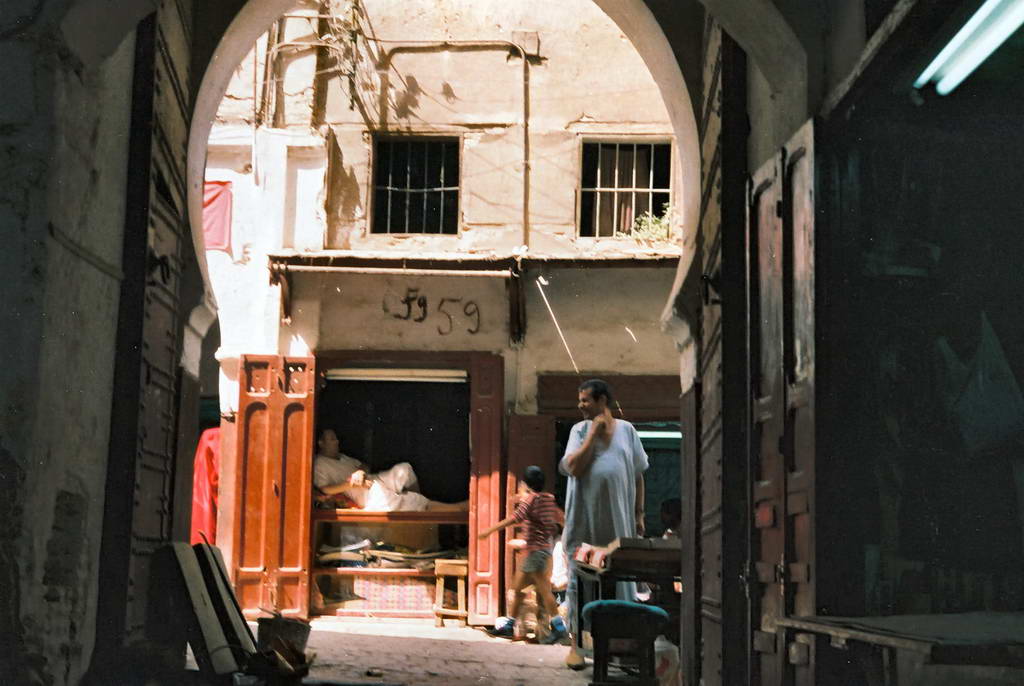
Most European visitors put Fes in a second row of priorities of their visit, concentrating mainly in Marrakesh or Casablanca. However, for me, Fes is the real gem of Morocco.
The sensation of wandering in the medina really leads to medieval times, like nowhere else in Muslim countries. I’ve been there twice, and though the second time didn’t confirm the emotions (and risks!) of the first one, it still shines for its authenticity and contrasts.
Don’t doubt. First priority for sure!
Rabat

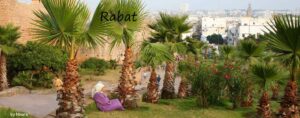
Modern city with character, Rabat the capital, deserves to be visited. The main attraction is the complex of Mohamed V tomb near Hassan tower, but the whole city is nice, with a few palaces in evidence.
Agadir
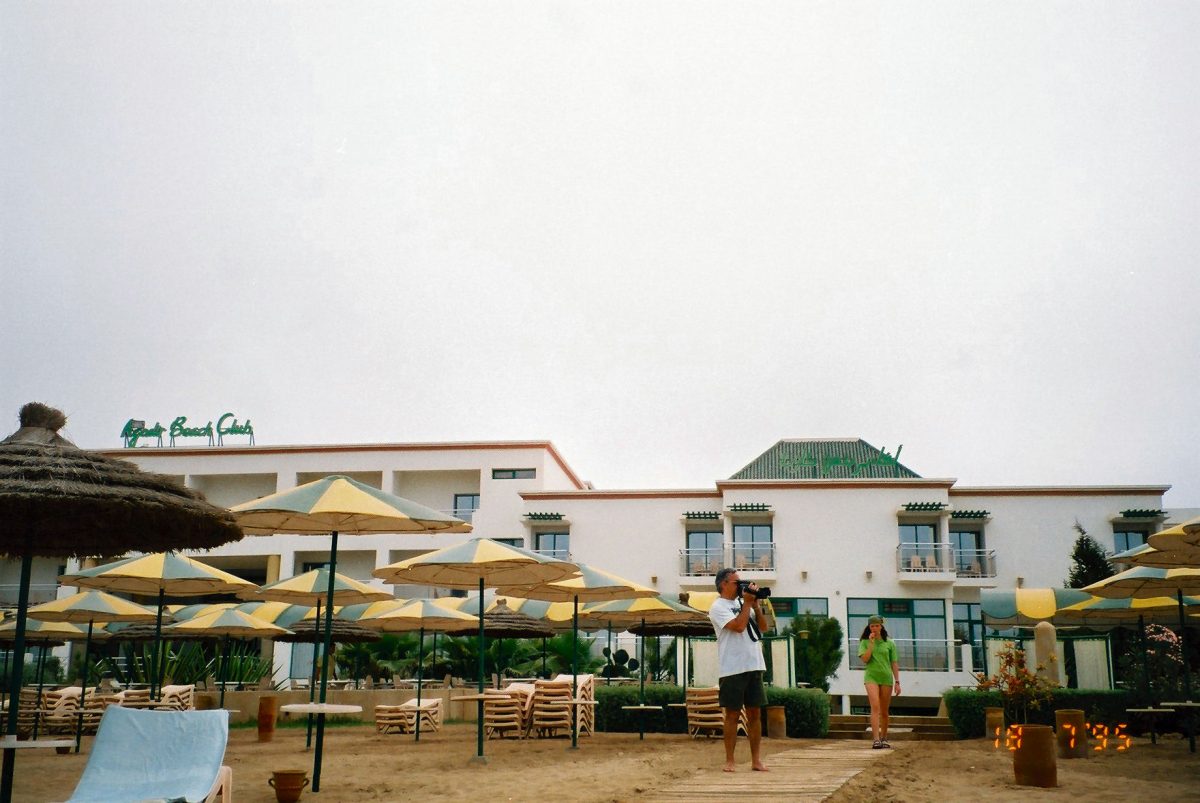
A week on the beach, took us to thee modern city of Agadir, rebuilt after a terrible earthquake. It was a good week, though with frequent fog covering the sea, but not the well secluded pool of the hote
Casablanca

I’ve been twice in Casablanca, and the size and modernity of the city, pushed it to a second plan in the strong sensation caught in Morocco. However, something was kept…
Marrakech

Marrakech challenges Fes as the most interesting cities of Morocco. More promoted for tourism, and much more touristy, it keeps, however, its authenticity.
Meknes

A walled city that composes the circuit of the imperial cities, Meknes seems to separate history and modernity, and deserves a full day visit.
Struggle for water

Olive trees are generalized in Mediterranean area, and Morocco is no exception. Being a resistant tree, it needs not too much water to survive, but… it needs some. That’s why we may see in Morocco the trees lined along trenches, trying to retain the few waters from raining.
Without the exuberance shown by the vineyards of Porto, it composes an interesting perspective of the struggle against the advance of the desert.
 Personal Memories
 Personal Memories
Out of Scale
We all have what I call “Our own scale”. I mean that we get acquainted to the usual distances, time scheduling, and rhythm of life, that, all together, compose that scale. That’s what makes our life predictable and controllable, easing decisions and the life itself. When we move to another country or society, sometimes things are different, forcing to an adapting time, until getting “fixed” in the new scale.

A tourist, usually, doesn’t have that time, so, travelling demands a special attention the “the scale”.
In a global world under the American culture, the differences are fading, turning the adaptation quick and easy, but, sometimes, surprises do happen. Then, you better be alert to that notion of scale.
If you do, you get a new point of observation of the visited place and will be able to enrich your knowledge understanding the differences.
But if you don’t then you will probably feel rather uncomfortable, and, if you need to go on planning next step of your trip, you risk making serious mistakes, spoiling the trip.
In my trips, I really felt out of scale twice: the first in 1982, in my first visit to Fes, in Morocco; the second one in Florida, in 1992 in my first visit to the USA. I was prepared and really enjoyed the feeling.
To know the details just follow the links.
A secret

As a Muslim country, Morocco has some restrictions concerning alcohol. As a touristy country, Morocco was forced to adapted to visitors’ tastes and needs, sometimes with… let’s say… imagination.
No!
I will not confess that the teapot had a very good and cool white wine. How could you imagine such a thing?
It was a delicious Iced Grape Tea, that’s what it was!
The long adventure
Visiting different countries is always an adventure, especially when facing significant cultural diversities.
All this gets worse when it comes to countries unprepared for tourism, and where the visitor appears as the opportunity for excellence to make easy money.
I had this experience in 1982, when, driving a Renault 4, I crossed the Strait of Gibraltar to five days in Morocco.
Although I had asked at the embassy of Morocco in Lisbon, the information was scarce – some simple tourist brochures, no map, so I went to visit a couple who had been in Tangier and Tetuan a few months before, asking for information.
When they understood that we would go by car with no one else or any kind of support, with the eyes widened, and after warning against false guides and motorcycle boys, they said goodbye to me as if they were convinced I would not return. The biggest question was how we would get back, if we survived, because the car was sure to be stolen.
Fortunately I was alone on this visit, and in reporting to my wife, I could omit the details that would make her give up.
We leave with an obsession of security, and some permanent tension.
The first stop was in Madrid, and that night the car was assaulted. I had carefully emptied it, taking everything to the hotel, so the only damage was the broken lock.
New stage, stop in Aranjuez to buy fruit, and the car refused to open. I had to ask the vendor for a screwdriver, and break again the lock to follow. The result is that I shouldn’t lock the car anymore, which means that I went to Morocco with a car that was supposed to be stolen, and that I could not close.
With the security paranoia I had previously booked hotels with garage, so I ventured.
The crossing to Ceuta was calm, but the panorama on the border was chaotic.
I stepped a millimeter to the millimeter in the line of cars, until a young man, in civilian, approached, made us stop and follow him with the documents.
We went to a wall with a tiny opening at the level of the head, where my escort had the passport placed. A moment later, a hand picked up the passport, which was soon returned.
We then proceeded to a small crowd clutching a long balcony, behind which two uniformed men drank tea, and gave us orders to place the passport on the counter.
After long minutes, one of the tea drinkers got up, picked up the dozens of passports planted on the counter, and stacked them on the desk where he sat again this time without tea.
One by one, he opened each passport, and glanced around the crowd for the face of the photograph. When he found it, he checked the visa and stamped the passport, putting it back on the desk, open on the visa page, facing down.
After the marathon, he left the pile of passports and went back to tea. The other, in a different uniform, decided to leave the tea as well and approach the documents.
He took a tiny stamp from his shirt pocket, and slowly added a second stamp to each visa.
When he had finished, the first returned to his place, and, repeating the ringlead of the photo, he handed the passports to the owners.
After the show we returned to the car, and the boy sat in the back seat.
I asked him to what purpose, and he explained to me that he would be my guide in Tetuan.
I noticed the maneuver and tried to discard him, with the excuse that we would not stop at Tetuan, offering him money.
It started a violent arguing, and ended up getting out of the car between insults, with a very good amount of money in his hand.
I truly thought to get back, but the hope that the incident would not repeat itself led me to continue.
A few kilometers before Tetuan, a motorcycle approached the car with a delicate greeting (the car had no air conditioning and the glass had to be opened) and announcing that he was my guide in Tetuan. I repeated the lie that I was not going to stop, and he turned around and went to wait for the next person.
Lunch would be in Tetuão, but with the car obligatorily open I wanted a esplanade where we could eat with the car in sight. Nothing I saw, so I took a few steps on a wide avenue that seemed safe and immediately I heard calling. I tried, without looking, to dismiss with a gesture who was following me, but he insisted, so I turned and faced a middle-aged man, who presented himself as a tour guide, and asked me if I needed help.
He seemed reliable, and I trusted him, explaining that I was looking for a place to have lunch, so he offered to accompany us to the “best restaurant in Tetuan.”
It was right there, and we went in, with him behind us, sitting with us at the table. I admitted that “kindness” would cost me a lunch (at least), so I invited him. He thanked gently, and the only thing he took was a beer.
It was a spectacular lunch, for the environment, for the food, and for the company.
The tables were gigantic trays of worked bronze, lunch a delicious couscous, and the gentleman a real professional guide (who even knew Portugal, where he had accompanied a group to Nazaré), and he supplied me precious information during lunch.
He showed me the official document that I should demand of each would-be guide, repeated the warning of the motorcycles, suggested visits, priorities, care to be taken.
Beautiful indeed.
Nobody had touched the car and was relieved that I left Tetuan to Fes, the site of our first night.
At the entrance of Fes new embarrassment: a fork forced me to choose between Fes-el-Bali or Fez-el-Jedid, without having the slightest idea of which to choose.
It was only a fraction of a second before the inevitable motorbike appeared. I explained to him that I wanted the Fes hotel, he told me to follow him.
We were entering the city, with me always peering at the end of the road, controlling the apparent security, but when the tar was over, Fernanda panicked and asked me to turn back.
The dirt road was wide, and intersections continued to be visible, which guaranteed an escape, so I went forward, and suddenly the tar came back and the boy stopped immediately pointing the hotel.
It was a relief, and when we stopped at the reception and wanted to gratify him, he refused, just asking me to accept him as a guide in the visit to the medina the next day.
I asked him if he had the official document, he assured me so, and then I accepted, with the warning that we would only go after seeing the document. I proposed to him 9 hours, but this was “dawn”, so we got the 10 o’clock.
Very nice night in a nice hotel, and at 10 o’clock I left the hotel, to meet an old man with a white djellaba, introducing himself as the chief of the hotel guides, and asking if I wanted a guide.
I told him the story of the day before, and he volunteered to help me to check the suitability of the motard.
It took a few minutes to arrive the motorbike, but … the face was different. I questioned him about this difference, and he argued that the other had not been able to come, and had asked him to replace him.
The old man entered the conversation, in Arabic, and after a few moments, he explained to me that “your friend was arrested tonight”.
I refused the new “guide” and accepted the old man’s help, which brought me a man without a hand (a bad sign in an Islamic country), but who was impeccable during the visit.
Visit ended, at my request, in a “good restaurant” allowing to walk to the hotel. So it was, but the “good restaurant” despite being full of Europeans, was hampered by the intense smell of lamb, present in everything up to the napkins.
We traveled without further incidents, except a stop to photograph a beautiful rural scene with a group of children by a well, having to run away to the car and accelerate under a rain of stones, happily thrown by hands very young and incompetent.
On the positive side, the sympathy of a driver in Casablanca, who, when at a crossroads, I asked him for directions to the hotel, he changed his way and led me there.
The adventure ended in Tangier, where with the car loaded with trinkets, which spill over even who does not want to buy anything, I had to park in a public place. A young man in a cap and a plaid at his chest introduced himself as a park guard, and I entrusted the car to him with a promise of good gratification.
When I returned the boy was the pivot of a band of small “guards”, all of them feeling to deserve a “backshish”.
I divided between them the few Moroccan money that I had left, but “it was not enough”. I turned my back on them and got into the car, but some jumped up, until they were convinced that even driving with extreme care to avoid accidents, I would not stop.
Already trained for border martyrdom, the exit proved much easier, only with the surprise of seeing a guard, suddenly unleashing a woman at our side, putting his hands inside the suit, to withdraw … a package of cookies.
I learned later that some of these women were drug couriers, so I can not guarantee the taste of the cookies.
What began as an adventure ended as an adventure, and it was only after relaxing at home that I discovered that the green card was not valid in Morocco, reason why all the adventure had been lived … without insurance. My God!

Useful in Morocco – 3 fine information
If you want to easily publish your own experiences, after registering you may use the form below. It will be added after revision. You may use text, photos till 20Mb or video. For a more complex publication click here.
Publishing form
You need to be logged in to view this page
Your trip will be perfect with the help of our partners
For a great experience:
For your safety:
For your comfort:
For cheap flights:
For local displacements:
 English
 Português